
 Back
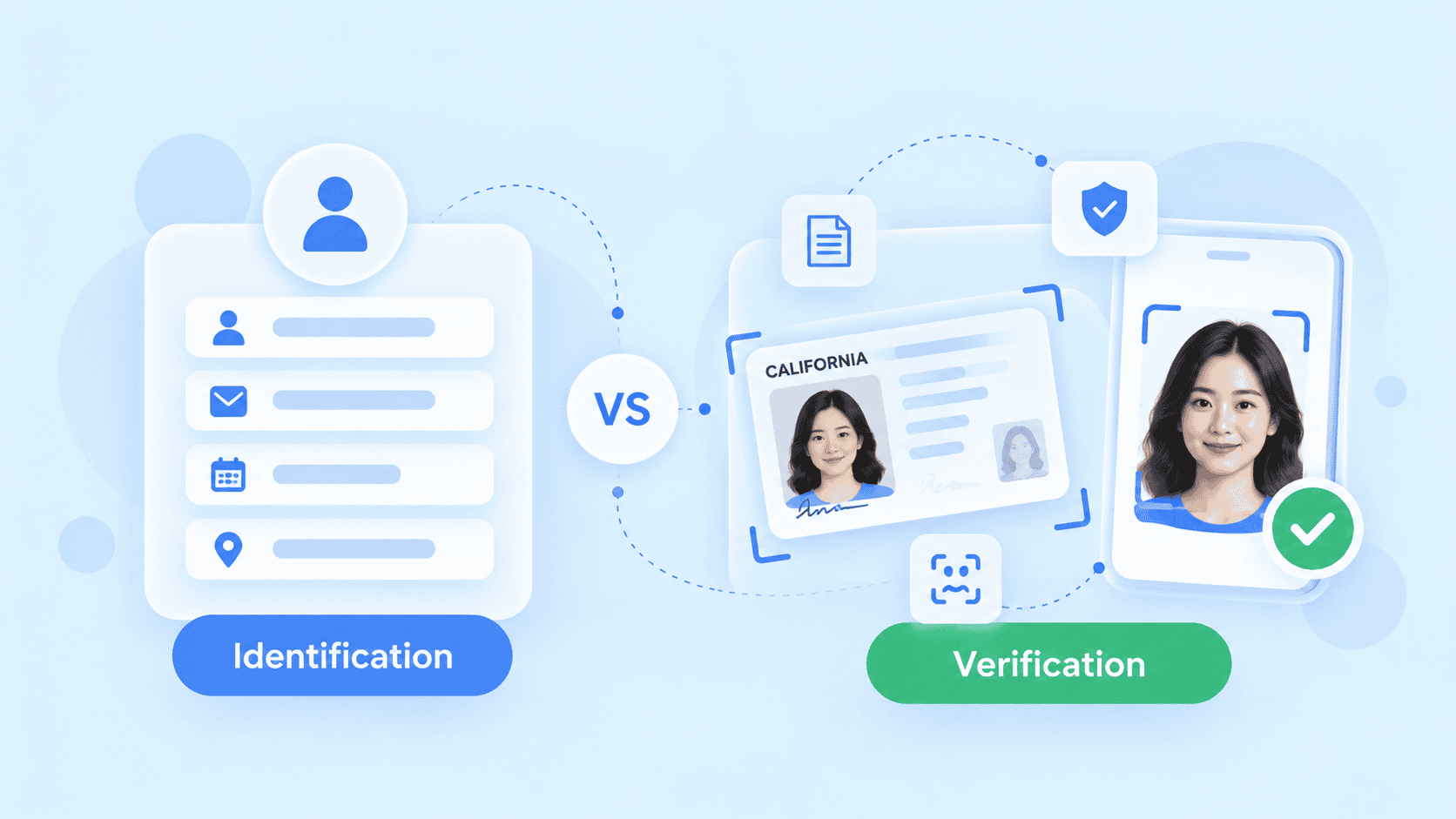
A system can know who someone claims to be without knowing whether that claim is true. That distinction is the foundation of identification vs verification.
Identification establishes or discovers an identity. Verification tests whether a person really is the individual associated with that identity. Authentication comes later, usually when an already-enrolled user needs to prove they are the same person returning to an account or service.
The terms often appear together in onboarding, KYC, access control, biometrics, fraud prevention, and account security. But treating them as interchangeable can lead to weak controls, unnecessary user friction, or identity checks that answer the wrong question.
This guide breaks down what each term means, where identity verification vs identification fits into a real workflow, and how identification, verification, and authentication work together.
Key Takeaways
- Identification asks “Who is this?” or establishes which identity a person is claiming.
- Verification asks “Is this person really that individual?” by connecting validated identity evidence to the person presenting it.
- Authentication usually happens after enrollment and asks whether a returning claimant controls an authenticator associated with an existing account.
- An ID document can help identify someone without being sufficient to verify that the person presenting it is the document owner.
- Good identity architecture applies each control at the correct stage instead of treating identification, verification, and authentication as synonyms.
Identification vs Verification: The Quick Answer
The simplest way to understand identification vs verification is to look at the question each process answers.
| Process | Main Question | Typical Inputs | Typical Outcome |
| Identification | Who is this person, or which identity are they claiming? | Name, username, email, account number, face search, identity attributes | A claimed or resolved identity |
| Verification | Is this person actually associated with that real-world identity? | Identity evidence, authoritative records, document checks, biometrics | Confidence that the claimed identity belongs to the applicant |
| Authentication | Is this the previously enrolled user returning now? | Passkey, cryptographic key, password, biometric-assisted authenticator | Access to an existing account or session |
The distinction closely follows the digital identity model used in the NIST Digital Identity Guidelines (SP 800-63-4). NIST separates identity resolution, evidence validation, identity verification, enrollment, and authentication rather than treating them as one generic identity check.
That separation matters because each stage protects against a different failure.
A name and date of birth may help identify a record. They do not prove that the person entering them owns that identity. A valid passport may establish strong identity evidence. It still does not automatically prove that the person holding the passport is its legitimate owner.
And a successful login may authenticate an account holder without repeating the complete identity-proofing process used when that account was created.
What Is Identification?
So, what is identification?
In a digital identity workflow, identification generally means determining or establishing which identity is associated with a person or interaction.
Sometimes the person states the identity directly:
“My name is Jordan Lee, and this is my account.”
In other cases, a system resolves identity from available attributes. For example, an application could use a customer number, email address, employee ID, or another identifier to locate a particular record.
Identification therefore does not necessarily prove that a claim is true. It establishes the identity that the rest of the process needs to evaluate.

Identification Can Also Mean Biometric Identification
The word becomes slightly more complicated in biometric systems.
A biometric 1:1 comparison asks whether a live biometric matches a specific enrolled reference. A 1 search, by contrast, compares a biometric against a gallery to determine which enrolled identity it may correspond to.
That 1 process is frequently called biometric identification.
For example, imagine an employee enters a secure facility without first entering a username or presenting an employee number. A facial recognition system searches enrolled references and determines that the face most closely corresponds to Employee 4821.
That is an identification operation because the system is answering:
“Which enrolled identity does this biometric belong to?”
By contrast, if Employee 4821 first presents an employee credential and then completes a facial comparison against that specific employee record, the biometric is supporting a one-to-one verification or authentication decision rather than discovering the identity from a larger population.
The important point is that identifying a record is not the same as proving the real-world identity behind it.
What Is Identity Verification?
Identity verification goes further.
It establishes whether an applicant is genuinely associated with the real-world identity represented by the evidence they provide.
That means a useful verification process needs more than a claimed identity.
Consider a new customer opening a financial account.
They provide:
- Their name and date of birth.
- A government-issued identity document.
- A live facial image.
- Other information required by the service.
The name and personal details identify the claimed person.
The document can then be checked to determine whether the identity evidence is authentic and whether its attributes appear valid. That is evidence validation.
Verification then connects that validated evidence to the actual applicant. One common method is comparing the person presenting the credential with the portrait contained in the validated identity document.
The NIST guidelines for identity proofing and enrollment (SP 800-63A) distinguish identity resolution, evidence and attribute validation, and identity verification as separate parts of the identity-proofing process.
This is why ID vs verification is not a useful one-to-one comparison. An ID document is evidence. Verification is the process used to establish whether that evidence legitimately belongs to the applicant.
Document Verification Is Only One Part of the Picture
A document can be genuine while being presented by the wrong person.
That is why higher-assurance workflows can combine several independent checks.
For example, a digital onboarding process might:
- Capture a government-issued document.
- Extract its identity attributes.
- Evaluate signs of alteration or counterfeiting.
- Validate information against an authoritative source where appropriate.
- Compare the person presenting the document with the portrait associated with it.
Private ID’s document verification workflow illustrates this separation by combining document capture and authenticity checks with selfie-to-photo-ID matching and optional authoritative data validation.
The individual checks answer different questions.
OCR can answer, “What information is printed on this document?”
Document authenticity checks can answer, “Does this evidence appear legitimate?”
An authoritative records check can answer, “Do these attributes correspond with a trusted source?”
Biometric comparison can help answer, “Is the applicant presenting the credential associated with the person represented by it?”
A strong identity-verification decision can therefore depend on several controls rather than a single “verified” flag.
Identification vs Authentication: Another Important Distinction
The phrase identification vs authentication describes another boundary that is easy to miss.
Identification generally establishes who the person is claiming to be or determines which identity record applies.
Authentication usually happens after the user has already been enrolled.
According to the NIST Authentication and Authenticator Management Guidelines (SP 800-63B), authentication involves a claimant demonstrating possession and control of authenticators bound to a subscriber account.
That changes the question.
During identity verification, a service may ask:
“Can we establish that this applicant is really Jordan Lee?”
During a later login, the service may instead ask:
“Is the person requesting access now the same subscriber associated with Jordan Lee’s account?”
That second question does not normally require repeating the entire original proofing workflow.
An authenticator could be a cryptographic credential, passkey, password, hardware device, or another supported authentication mechanism. Biometrics may also participate in authentication, depending on the architecture.
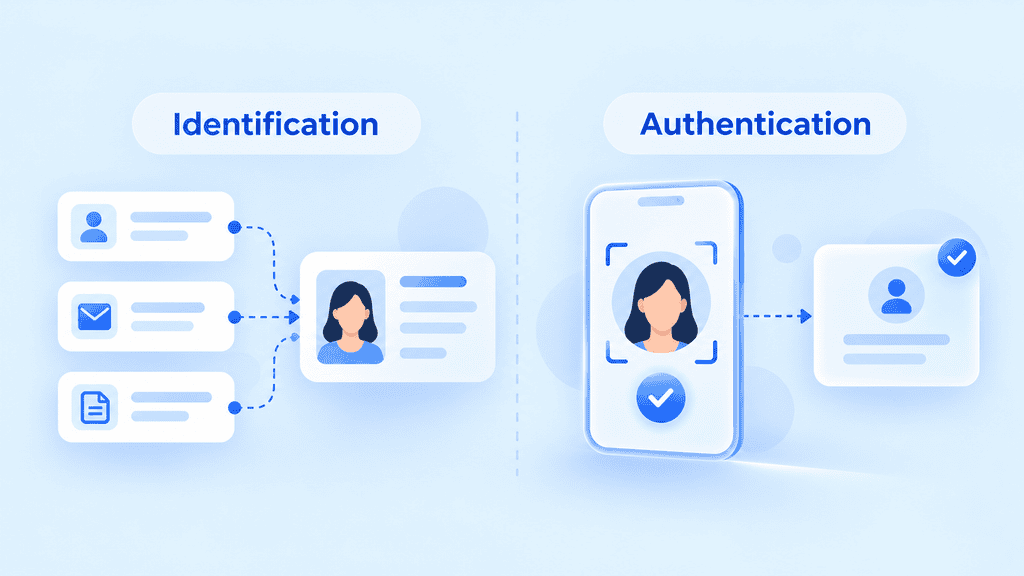
For example, Private ID’s biometric authentication offering combines facial biometric functionality with passkey-based authentication for returning-user scenarios.
This is a useful illustration of the difference between verify vs identify and authenticate:
- Identification determines which identity is involved.
- Verification establishes confidence that the identity belongs to the applicant.
- Authentication establishes that a returning claimant controls an authenticator associated with the enrolled identity.
They may happen within one customer journey, but they solve different security problems.
Why Identification vs Verification Matters in Real Systems
Confusing the terms is not just a vocabulary issue. It can change how a system is designed.
Identification Alone Can Create False Confidence
Suppose an account-opening form asks for a name, address, date of birth, and government identifier.
Those attributes may allow the system to locate a real individual.
That does not prove that the applicant is that individual.
A fraudster using stolen personal information could potentially supply enough accurate attributes to identify a victim while still failing a properly designed identity-verification process.
This is one reason identity proofing includes more than identity resolution. Proofing requires evidence and appropriate checks before a service can establish confidence in the claimed identity.
Document Validation Alone May Leave an Ownership Gap
A second mistake is assuming that a valid document equals a verified person.
Imagine an applicant presents a genuine driver’s license belonging to someone else.
The document itself could pass authenticity checks. Its text could be extracted correctly. Its number could even correspond to a valid issuing record.
But the critical question remains:
Does this credential belong to the applicant presenting it?
A verification step that connects validated evidence to the individual is designed to close that gap.
Re-Verifying Everyone at Every Login Creates Unnecessary Friction
The reverse mistake also occurs.
Once a user has been properly identity-proofed and enrolled, asking them to repeat full document verification during every sign-in would often create excessive friction.
Authentication exists so an organization can recognize a returning subscriber using authenticators bound to the established account.
The appropriate control depends on the event.
A routine sign-in might require authentication.
Changing highly sensitive account information might justify step-up authentication.
Opening a new regulated account might require identity proofing and verification.
Recovering an account after the original authenticator is lost may require a stronger recovery process because the service must regain confidence in who is requesting control.
Thinking clearly about identification vs verification helps teams choose controls based on the actual question being answered.
The Distinction Also Affects Privacy
Collecting more identity data does not automatically produce more trustworthy identity decisions.
If a workflow only needs authentication of an already-enrolled user, repeatedly requesting government identity documents may expose more personal data than the transaction requires.
Similarly, some services need to confirm only a specific attribute, such as whether a person is above an age threshold, rather than reconstructing the user’s complete identity.
Separating identification, verification, authentication, and attribute verification allows organizations to design more proportionate workflows.
The principle is simple: establish the level of identity assurance the decision requires, then collect and process the information necessary to achieve it.
How Identification, Verification, and Authentication Work Together
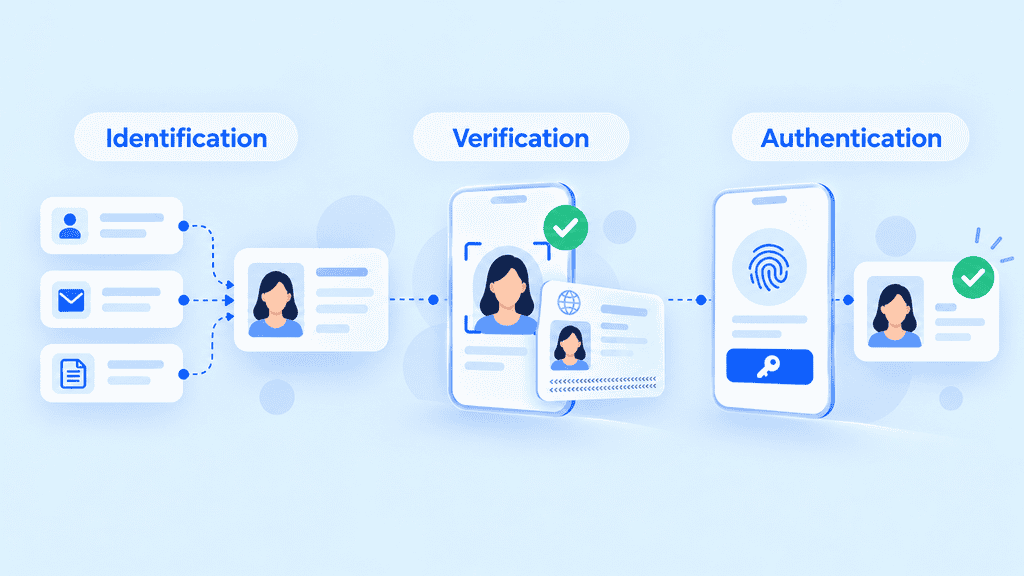
The clearest way to understand these concepts is as stages in a customer lifecycle rather than competing technologies.
Consider a marketplace that needs verified sellers.
1. The Seller Presents a Claimed Identity
The seller submits information such as their name and other required identity attributes.
At this stage, the platform knows which identity is being claimed.
That is the identification or identity-resolution problem.
2. The Platform Verifies the Claimed Identity
The seller supplies acceptable evidence.
Depending on the platform’s risk model, the workflow could validate a document, check attributes against authoritative sources, perform a biometric comparison, evaluate liveness, or use several independent signals.
The goal is to establish that the applicant is genuinely associated with the real-world identity represented by the evidence.
Private ID describes its identity management and verification capabilities as supporting configurable verification methods, document validation, liveness detection, database checks, and identity workflows.
3. The Verified Person Is Enrolled
After successful identity proofing, the service can establish an account and bind one or more authenticators to it.
At that point, the identity decision becomes reusable.
The platform no longer needs to rediscover the seller’s real-world identity during every routine interaction.
4. Future Visits Use Authentication
When the seller returns, authentication determines whether the claimant controls the authenticator associated with the established subscriber account.
The identity-proofing and authentication stages serve different purposes. Identity proofing establishes confidence in the real-world identity, while subsequent authentication checks whether the claimant can demonstrate control of an enrolled authenticator.
This lifecycle also explains why no single technology should be described as universally providing “identity.”
A facial comparison, document check, database lookup, passkey, or biometric search can each contribute to identity security. What matters is the question being asked, what evidence the system already has, and where the user is in the lifecycle.
Choosing the Right Identity Control
When designing a workflow, start with the business decision rather than the technology.
| Business Question | Primary Identity Function |
| Which customer record does this request relate to? | Identification |
| Is this identity document authentic? | Evidence validation / document verification |
| Does this applicant actually own the claimed identity? | Identity verification |
| Is this the same enrolled user returning to the account? | Authentication |
| Which enrolled person does this biometric appear to match? | Biometric identification / 1 search |
| Does this biometric match the specific identity already presented? | 1:1 biometric verification or authentication, depending on context |
That distinction prevents teams from choosing a control simply because it is described as an “identity check.”
Before deploying a workflow, define exactly what must be established:
Do you need to discover an identity, prove a claimed identity, validate evidence, or authenticate an identity that was already established?
The answer determines which controls belong in the process.
Conclusion
The central difference in identification vs verification is the level of proof involved.
Identification determines or establishes which identity applies. Verification tests whether the person presenting that identity is genuinely associated with it. Authentication then allows an enrolled user to prove they are the same subscriber returning later.
Keeping those functions separate makes identity systems easier to reason about. More importantly, it helps organizations apply stronger checks where they matter without collecting unnecessary information or forcing users through identity proofing when authentication would answer the actual question.
FAQs
What Is the Difference Between Identification and Verification?
Identification establishes who someone claims to be or determines which identity record corresponds to them. Verification goes further by confirming that the applicant is genuinely associated with the claimed real-world identity using validated evidence and appropriate verification methods.
Is Identification the Same as Identity Verification?
No. Identification can establish a claimed or resolved identity without proving ownership of it. Identity verification is specifically concerned with establishing that the person undergoing the process actually holds the identity represented by the validated evidence.
What Is the Difference Between ID and Verification?
An ID is generally a credential or piece of identity evidence, such as a passport or driver’s license. Verification is a process. A system may validate the ID itself and then perform additional checks to establish that the document belongs to the applicant presenting it.
What Is the Difference Between Identification and Authentication?
Identification determines which identity is involved. Authentication generally occurs after enrollment and establishes that a returning claimant controls one or more authenticators associated with an existing subscriber account.
Does a Password Verify Someone’s Identity?
Not necessarily. A password can authenticate access to an account if the claimant knows the correct secret, but it does not by itself establish that the account belongs to a particular real-world person. That relationship depends on how the identity was established during enrollment.
Is Facial Recognition Identification or Verification?
It can be either depending on how it is used. A one-to-many biometric search can be used for identification because it attempts to determine which enrolled identity matches the biometric. A one-to-one comparison against a specific claimed identity can support verification or authentication depending on the stage of the user journey.
Why Does the Difference Between Identification and Verification Matter?
It prevents organizations from assuming that locating a real identity is equivalent to proving that the applicant owns it. The distinction also helps teams avoid unnecessary verification steps for already-enrolled users and select controls that match the actual fraud, security, and privacy risk.