
 Back

A biometric system can match the correct face and still make the wrong security decision. If an attacker can present a photograph, replay a video, wear a realistic mask, or manipulate the camera input, accurate face matching alone does not prove a live person is actually present.
That is the problem presentation attack detection software is designed to solve.
PAD evaluates biometric capture for signs that the input is being presented or manipulated to fool the system. Although the term is often used interchangeably with liveness detection, buyers evaluating PAD software need to look beyond a vendor’s “liveness” label. Independent testing, attack coverage, deployment architecture, false-rejection behavior, and the exact product version tested all matter.
This guide compares ten notable presentation attack detection vendors with a specific emphasis on those procurement questions. It deliberately focuses on PAD rather than repeating a broader comparison of general liveness-detection platforms already covered by PrivateID.
Key Takeaways
- Presentation attack detection is specifically concerned with attacks against biometric capture, including photographs, displays, video replays, masks, and other presentation attack instruments.
- ISO/IEC 30107-3 provides a standardized framework for PAD testing and reporting, but it does not certify an entire identity system against every form of biometric fraud.
- An iBeta PAD certification or confirmation letter should be checked against the exact product version, platform, biometric modality, and test level being deployed.
- PAD and injection-attack detection are related but different problems. A system that performs well against objects presented to a camera may still need separate controls against virtual cameras, emulators, compromised endpoints, or injected media.
- Production testing should measure both attack rejection and what happens to legitimate users across real devices, lighting conditions, and capture environments.
What Is Presentation Attack Detection Software?
Presentation attack detection software analyzes biometric input to determine whether something is being presented to the sensor with the intention of interfering with biometric recognition.
For facial biometrics, that could include:
- Printed facial photographs.
- A face displayed on another phone or monitor.
- Video replay.
- Paper cutouts.
- Realistic masks or three-dimensional artifacts.
- Other physical or digital representations presented to the camera.
The current ISO/IEC 30107-3:2023 standard establishes principles and methods for evaluating PAD mechanisms, reporting test results, and classifying known presentation attack types. Importantly, its scope centers on attacks occurring at the biometric capture device. It does not claim to evaluate every possible attack against the wider application, API, endpoint, or identity system.
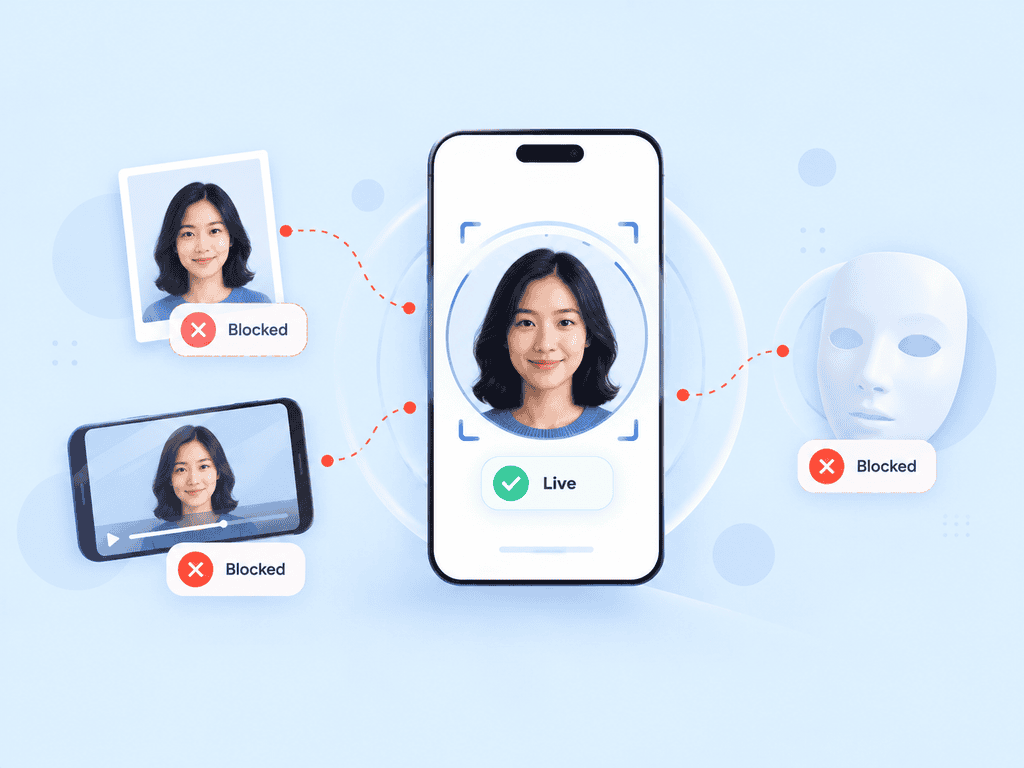
Liveness detection is one form of PAD. A face-liveness system may look for evidence that the captured subject is genuinely present rather than a reproduction. PrivateID’s guide to what liveness detection is explains the distinction between confirming a live capture, identifying whose face is present, and ultimately deciding whether access should be granted.
That distinction matters when comparing anti-spoofing PAD products. A provider may combine PAD, facial recognition, document verification, device intelligence, and injection detection, but those controls solve different parts of the fraud problem.
How We Evaluated PAD Software
This list is not a ranking of which vendor is universally “most secure.” PAD performance cannot be reduced to a single badge or marketing claim.
The comparison instead considers five practical factors.
Independent biometric PAD testing. Preference is given to products with publicly documented ISO/IEC 30107-3 testing, particularly where an iBeta confirmation letter or equivalent independent evidence can be checked.
Attack coverage. The comparison looks at whether a solution addresses commonly encountered presentation attacks such as photographs, screens, video replays, and masks.
Passive versus active operation. Passive PAD can reduce user friction because the user does not have to perform a challenge. Active approaches may introduce movements, actions, or other interaction where a workflow calls for them.
Deployment architecture. Processing may happen on the user’s device, on a vendor’s servers, or through a combination of client and server components. That affects latency, data movement, privacy design, and operational dependencies.
Broader fraud controls. PAD stops a particular family of attacks. Organizations may separately need defenses against deepfake injection, virtual cameras, compromised devices, stolen credentials, manipulated documents, account takeover, or synthetic identity fraud.
The product details below should therefore be treated as a procurement shortlist rather than a laboratory ranking. Certification status and product versions can change, so buyers should request current test evidence before contracting.
Top 10 Presentation Attack Detection Solutions
1. PrivateID
PrivateID is particularly relevant for organizations that want PAD performed locally rather than sending facial imagery to a remote liveness service.
Its passive liveness capability operates on the user’s device and is designed to detect presentation attacks involving paper images, displays, masks, and deepfake-related spoofing. This can be combined with PrivateID’s broader facial recognition, document verification, authentication, and identity-proofing capabilities.
The architecture is the differentiator. PrivateID describes its liveness detection as on-device processing in which images do not need to leave the device for anti-spoofing analysis.
There is also independent test evidence behind the PAD claim. Private Identity’s PrivateID Verify v1.2.8 completed iBeta Level 1 and Level 2 PAD testing in 2025. The Level 2 test used an iPhone 16 Pro and included 750 presentation attacks across five attack species. iBeta reported an APCER of 0% in that specific evaluation.
PrivateID has separately published information about its iBeta PAD Level 1 and Level 2 assessments.
Best suited for: Organizations prioritizing passive PAD, edge processing, biometric privacy, and integration with a wider identity platform.
2. iProov
iProov is a specialist biometric provider with a strong emphasis on determining whether an online user is genuinely present during remote verification.
Its portfolio includes Dynamic Liveness and Express Liveness. The company has documented independent ISO/IEC 30107-3 testing by iBeta for PAD Levels 1 and 2.
iProov’s approach is particularly relevant to enterprises with high-assurance remote onboarding or authentication requirements where detecting sophisticated biometric impersonation is central to the threat model.
Organizations evaluating the platform should distinguish between presented attacks and digitally injected attacks, then establish which product and security layer is responsible for each.
Best suited for: High-assurance remote identity workflows where biometric spoofing and deepfake-related threats are major procurement considerations.
3. FaceTec
FaceTec is a long-established participant in facial liveness and biometric identity verification. Its 3D liveness technology has undergone independent PAD evaluation, including iBeta Level 2 testing.
An iBeta evaluation of FaceTec’s ZoOm technology tested six artifact species and 1,800 presentation attacks. The laboratory reported no successful presentation attacks in that particular evaluation.
FaceTec is frequently considered where organizations want liveness integrated into a wider face-verification workflow rather than deploying a basic single-frame spoof classifier.
Because some publicly available testing is tied to earlier software releases, procurement teams should request test evidence corresponding to the currently proposed production version rather than assuming historical testing automatically covers every later release.
Best suited for: Organizations looking for mature facial liveness technology embedded within a broader biometric verification architecture.
4. Jumio
Jumio combines liveness with identity verification and document-based onboarding workflows.
Its current liveness offering uses facial capture with automated guidance and is designed to distinguish a physically present user from presentation methods such as photographs, display attacks, and masks.
Jumio announced Level 2 ISO/IEC 30107-3 conformance following testing by iBeta in 2025. iBeta’s public testing register identifies Jumio’s PAD SDK and associated iOS application among products evaluated at Level 2.
The platform is most relevant where PAD is not being purchased as a standalone signal. It can form part of a complete onboarding journey involving identity documents, facial comparison, and fraud checks.
Best suited for: Businesses wanting PAD inside an established document-and-selfie identity verification flow.
5. Veriff
Veriff provides biometric liveness as part of its broader identity verification and fraud-prevention platform.
Its passive liveness process is intended to verify presence without requiring unnatural actions from the user. The company describes coverage for presentation attacks involving masks, presented screens, and AI-generated facial media.
Veriff’s biometric liveness technology has undergone iBeta Level 2 testing under ISO/IEC 30107-3. The published result reported an IAPAR of 0% during the evaluated presentation attacks.
For procurement teams, Veriff makes the most sense when liveness will sit alongside other identity evidence rather than operate as an isolated PAD SDK.
Best suited for: Digital onboarding programs that need passive liveness integrated with a wider identity decisioning process.
6. Regula
Regula is best known for identity-document verification, but its Face SDK also includes facial recognition and liveness detection.
The SDK provides both active and passive liveness options and has undergone Level 1 and Level 2 PAD testing. Regula’s workflow can connect face capture, image-quality analysis, liveness, and face matching against a document portrait or another reference image.
That combination may be attractive to organizations that already treat document authenticity and biometric comparison as closely connected controls.
Regula also provides server-side biometric processing options, making architecture an important part of the evaluation. Teams with strict requirements around local processing should compare that architecture against solutions designed primarily for on-device inference.
Best suited for: Document-heavy onboarding processes that also need facial PAD and face-to-document matching.
7. Entrust
Entrust’s identity-verification capabilities include technology acquired through Onfido, a vendor with a substantial history in facial biometric verification.
Onfido’s Liveness Video 2.0 underwent iBeta Level 2 PAD testing on both Android and iOS. In an Android evaluation, iBeta performed 750 presentation attacks across five species and reported an APCER of 0% for the tested system.
More recent iBeta records also list Entrust products, illustrating an important procurement issue: an organization should identify exactly which current Entrust product, mode, version, and platform corresponds to the independent test evidence supplied during a sales process.
Best suited for: Enterprise identity programs already evaluating Entrust for wider identity verification, authentication, or credentialing requirements.
8. Sumsub
Sumsub offers liveness and facial biometric controls within a broader KYC, identity verification, and fraud-prevention platform.
The provider is notable for recent independent PAD activity. iBeta’s public register lists Sumsub Liveness among evaluated products, including a Level 3 result in September 2026.
That does not mean buyers should interpret “Level 3” as a universal guarantee against all deepfakes or biometric fraud. The underlying confirmation letter, tested version, attack species, platform, and test conditions remain more useful than the level number alone.
Sumsub will generally be more attractive to teams that need PAD as one component of a broader compliance and transaction-monitoring environment.
Best suited for: KYC programs wanting liveness alongside document checks, fraud controls, and ongoing identity workflows.
9. ZOLOZ
ZOLOZ provides facial biometric and identity verification technology, including liveness capabilities used across digital onboarding and financial-service scenarios.
Its Native SDK appears in iBeta’s testing register with Level 1 testing in 2025 followed by Level 2 testing in May 2026.
For global enterprises, ZOLOZ can be worth evaluating where mobile-first biometric onboarding and regional deployment requirements are significant.
As with every vendor in this list, buyers should not use the existence of an iBeta entry as the entire security assessment. Confirm which SDK version is being offered, whether the tested operating systems match production, and which attacks sit outside the PAD boundary.
Best suited for: Mobile identity verification programs, particularly organizations evaluating biometric infrastructure across multiple markets.
10. Shufti Pro
Shufti Pro provides biometric verification, liveness, and identity-proofing capabilities alongside document and KYC workflows.
It stands out in the current iBeta register because its SDK was recorded as completing Level 3 PAD testing in April 2026. The register identifies specific Android and iOS versions and a 10% BPCER/FNMR limit associated with that test entry.
That provides useful independent evidence, but it should still be examined in context. Level 3 describes a particular laboratory test effort against defined attack instruments. It does not establish resistance to every remote injection or compromised-device scenario.
Best suited for: Identity-proofing teams that place substantial weight on recent higher-effort third-party PAD testing.
How to Compare iBeta PAD Certification
The phrase iBeta PAD certification is commonly used in procurement discussions, but buyers should be more precise.
iBeta is an independent testing laboratory accredited through NIST’s National Voluntary Laboratory Accreditation Program for relevant biometric testing. It evaluates products according to ISO/IEC 30107-3 methodologies and publishes confirmation letters for many completed assessments.
Its PAD confirmation-letter register identifies the vendor, product, version, PAD level, test date, and applicable BPCER or FNMR limit.
Five questions are especially useful when reviewing a result.

Was the exact production version tested?
A result belongs to the product and configuration named in the report. A letter covering version 1.2.8 should not automatically be treated as proof that an architecturally different later release behaves identically.
Which PAD level was completed?
The levels indicate increasing test effort and sophistication within iBeta’s methodology.
A higher level can be valuable evidence against harder presentation attacks, but procurement teams should resist turning it into a simple “Level 2 beats Level 1” checkbox. The actual threat model matters.
Which devices and operating systems were evaluated?
A test performed on one iPhone or Android handset does not automatically reproduce the behavior of every webcam, kiosk, embedded camera, low-cost smartphone, or browser.
This becomes particularly important when the production population uses a wide range of hardware.
What happened to genuine users?
Attack rejection is only one side of biometric PAD testing.
Two important measures are:
- APCER, or Attack Presentation Classification Error Rate, measures attacks incorrectly classified as bona fide.
- BPCER, or Bona Fide Presentation Classification Error Rate, measures genuine presentations incorrectly classified as attacks.
A PAD system that rejects attacks but creates excessive failures for genuine customers may simply move the organization’s problem from fraud losses to abandonment and support costs.
Does the test cover the attacks you actually face?
ISO/IEC 30107-3 addresses presentation attacks at biometric capture. It explicitly does not represent a full system-level vulnerability assessment.
An attacker who bypasses the physical camera and injects manipulated frames into an application presents a different technical problem.
This distinction has become important enough that the current NIST Digital Identity Guidelines separately discuss PAD and the integrity of sensors and endpoints. For facial recognition, NIST says PAD shall be implemented and recommends deployment testing that demonstrates an impostor attack presentation accept rate below 0.07. NIST also calls attention to compromised endpoints, sensor emulators, and similar injection risks.
PAD should therefore be one layer of the biometric threat model, not its boundary.
How to Choose Presentation Attack Detection Software
Start with the attack model, not the vendor list.
Suppose a financial application has seen three different fraud patterns:
- Criminals holding printed victim photographs in front of a phone.
- Fraudsters replaying facial video on another screen.
- Attackers using a virtual camera to feed manipulated media directly into the onboarding application.
The first two are classic presentation-attack scenarios. The third can bypass the normal physical presentation path entirely.
Buying “certified liveness” without separating those risks may leave the organization with strong protection against the easiest attack while missing the one currently driving fraud.
A practical PAD evaluation should include the following questions.

What attacks must be rejected? Document the presentation attack instruments relevant to your workflow: prints, displays, replayed video, cutouts, masks, and other artifacts. Separately document injection and endpoint attacks.
Where does processing happen? Determine whether biometric images leave the device, whether raw frames reach a cloud service, and what is stored after the decision. On-device processing may reduce data movement and centralized biometric exposure, while centralized processing may support other operational architectures.
How much user interaction is acceptable? Passive PAD may suit frequent authentication or consumer onboarding where completion rate matters. Active checks can be considered for particular step-up scenarios.
What happens after failure? A mature implementation distinguishes between a probable attack, poor lighting, motion blur, camera obstruction, and an unsupported device. Sending every failure into the same rejection path creates avoidable customer-service problems.
Can the vendor provide current evidence? Ask for the full testing scope behind certification claims, including product version, operating system, device, attack species, APCER, BPCER, and date.
Can you test the production environment? Laboratory results are valuable because they create repeatable independent evidence. They are not a substitute for testing your own device mix and user population.
For example, a lender might run a pilot across inexpensive Android phones, recent iPhones, and laptop webcams while deliberately varying backlighting, glasses, skin tones, network conditions, and camera quality. The team can then measure attack acceptance, genuine-user rejection, capture retries, and completion rate.
That produces a much better procurement decision than comparing certification logos alone.
PAD Software Should Be Evaluated as a Security Control, Not a Badge
The strongest presentation attack detection program combines standardized testing with a realistic understanding of the production threat.
Independent testing matters. ISO/IEC 30107-3 creates a common language for evaluating PAD, and iBeta confirmation letters can provide valuable evidence about a specific product and test configuration.
But successful deployment still depends on what happens outside that laboratory boundary: your cameras, users, applications, endpoints, privacy architecture, fallback rules, fraud patterns, and integration design.
When comparing presentation attack detection software, the right question is therefore not simply, “Does this vendor have PAD?”
Ask, “What exactly was tested, against which attacks, on what version, where does processing occur, and what other controls protect the capture path?”
That is the difference between buying a liveness feature and engineering meaningful resistance to biometric spoofing.
FAQs
What is presentation attack detection software?
Presentation attack detection software evaluates biometric input for signs that an attacker is presenting an artifact or representation to the biometric capture system. In facial biometrics, examples can include photographs, displayed faces, replayed video, cutouts, and masks.
Is PAD the same as liveness detection?
Not exactly. Liveness detection is commonly used as a PAD technique because it determines whether a biometric sample appears to come from a live person who is present during capture. PAD is the broader standards terminology for detecting presentation attacks.
What is ISO/IEC 30107-3?
ISO/IEC 30107-3 is an international standard covering principles and methods for performance assessment and reporting of biometric presentation attack detection. It focuses on attacks occurring during presentation at the biometric capture device rather than providing a complete security assessment of the entire identity system.
What does iBeta PAD Level 2 mean?
Level 2 describes an iBeta testing effort involving more time and more sophisticated presentation attack instruments than Level 1. Buyers should review the actual confirmation letter because the product version, device, attack species, test limits, and results are more informative than the level label by itself.
Does PAD detect deepfake injection attacks?
Not necessarily. A deepfake displayed to a camera can behave like a presentation attack, while a deepfake fed directly into an application through a virtual camera or compromised capture pipeline is an injection attack. Vendors may provide defenses for both, but organizations should verify the two capabilities separately.
What are APCER and BPCER?
APCER measures the proportion of attack presentations incorrectly classified as genuine. BPCER measures genuine presentations incorrectly classified as attacks. Both matter because a PAD system needs to resist attacks without causing unacceptable rejection rates for legitimate users.
What should businesses test before deploying PAD software?
Test the actual devices, operating systems, browsers, lighting conditions, camera quality, demographics, and attack types expected in production. Teams should measure both attack acceptance and genuine-user completion, while separately evaluating injection attacks and compromised endpoints.