
 Back
Back
A fake video call can now look convincing enough to fool a busy support agent, hiring manager, or onboarding team. That is why what is deepfake detection has become more than a media literacy question. It is now a security, identity, and trust question.
This guide explains how AI deepfake detection works in practical terms, especially for identity verification, video review, age assurance, and digital media workflows where “looks real” is no longer enough.
Key Takeaways
- Deepfake detection identifies whether media has been generated, altered, replayed, or injected using AI or other manipulation methods.
- Effective detection uses more than one signal, including facial movement, texture, lighting, metadata, provenance, liveness, and device integrity.
- AI deepfake detection is strongest when paired with identity proofing, biometric checks, and presentation attack detection.
- No tool can prove authenticity in every scenario, so high-risk workflows should use layered controls instead of one detector.
- Privacy matters. Detection systems should reduce unnecessary image storage, limit data transfer, and process sensitive signals as close to the device as possible.
What Is Deepfake Detection?
Deepfake detection is the process of analysing images, video, or audio to identify signs that the media has been synthetically generated or manipulated. In simple terms, it asks: “Was this captured from a real person or event, or has AI changed what we are seeing or hearing?”
Deepfakes are a subset of synthetic media. The UK government describes synthetic media as video, image, text, or audio generated partly or fully by AI, while deepfakes specifically misrepresent someone or something through AI-generated or manipulated audiovisual content. The UK government’s deepfake detection technology guidance makes this distinction because not all synthetic content is harmful, but deceptive synthetic content can create serious risk.
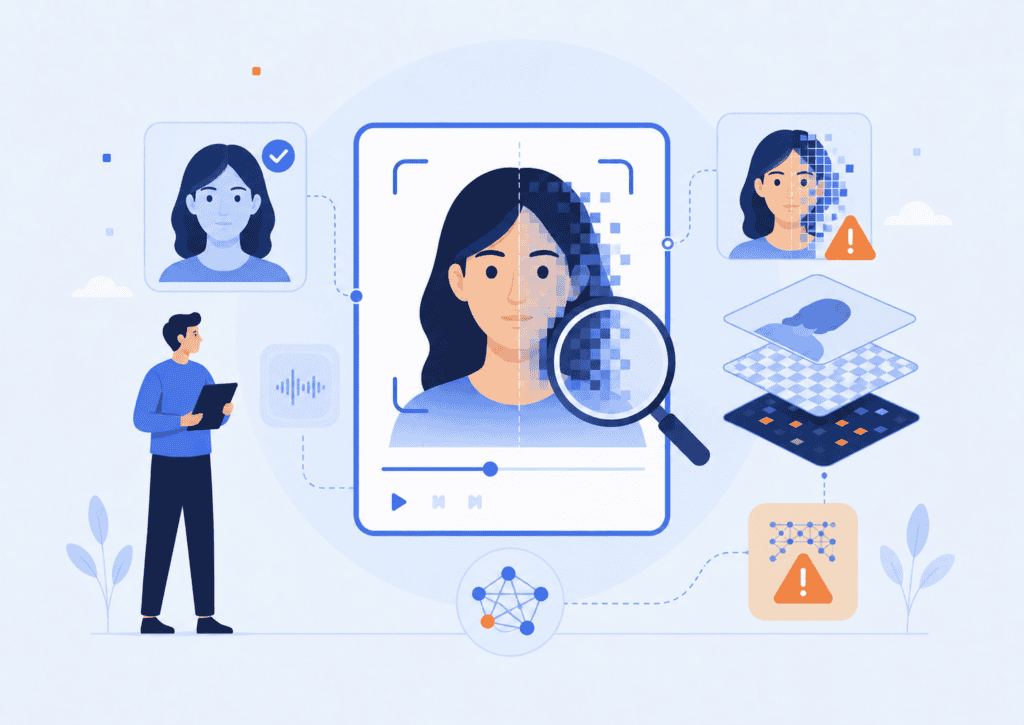
For businesses, deepfake identification is not only about spotting fake celebrity videos. It matters when a person is trying to open an account, pass an age check, access a restricted platform, join a remote interview, approve a payment, or appear in a video stream.
A practical detector does not rely on one clue. It looks for a pattern of evidence. A manipulated face may have unusual skin texture. A generated video may have inconsistent lighting from frame to frame. A replay attack may look visually normal but fail liveness checks. An injected video feed may bypass the camera entirely.
That last point is important. Deepfake detection technology should not only ask whether the media looks synthetic. It should also ask whether the media came through a trustworthy capture path.
How Deepfake Detection Works
Deepfake detection tools usually combine several technical approaches. Each approach catches a different type of manipulation, and each has limits.
Visual forensic analysis
Visual forensic models examine the pixels and frames of an image or video. They look for subtle signals humans often miss, such as:
- Blending artefacts around the face, hairline, ears, or jaw.
- Inconsistent eye reflections or unnatural blinking.
- Skin texture that looks too smooth or changes oddly between frames.
- Lighting that does not match the background or body.
- Compression patterns that differ across parts of the image.
- Mouth movement that does not align with speech.
This is the part most people imagine when they think about what is deepfake detection. The AI model has been trained to compare real media against manipulated media and identify statistical patterns.
The problem is that modern generators are improving quickly. A detector trained on last year’s artefacts may miss newer fakes. That is why serious AI deepfake detection has to be updated continuously and tested against adversarial examples, not just obvious samples.
Temporal and motion analysis
Video creates another layer of evidence because a face has to remain consistent across time. A still image can be polished. A 30-second video has to preserve identity, expression, lighting, head pose, and lip movement across hundreds of frames.
Temporal analysis looks for changes between frames. For example, a detector may flag a face that looks consistent in single frames but becomes unstable during head turns, fast speech, or partial occlusion. Ears may shift shape. Teeth may appear and disappear unnaturally. The edges of glasses may distort.
This is especially relevant for video onboarding, livestreaming, remote work checks, and video conferencing. PrivateID’s MediaSafe deepfake detection is built around real-time video stream identity tracking, where the system has to identify, age-estimate, and detect deepfakes in live video contexts rather than after a manual review.
Audio and voice signal analysis
Deepfakes are not limited to faces. Voice cloning can imitate a person’s speech patterns, accent, and tone from a small sample. Audio deepfake detection looks for features such as unnatural pauses, missing breath patterns, spectral artefacts, over-clean frequency bands, and mismatch between voice and mouth movement.
For identity workflows, audio alone is usually not enough. A cloned voice may pass a casual listening test, especially over a compressed phone or video call. Stronger workflows compare multiple signals: the voice, the face, the device, the session behaviour, and the user’s verified identity.
Provenance, watermarking, and content credentials
Not every authenticity check has to rely on detecting artefacts after the fact. Provenance systems try to preserve a record of where content came from and how it was edited.
The Coalition for Content Provenance and Authenticity (C2PA) provides an open technical standard for recording content origin and edits through Content Credentials. Its specification includes manifests, claims, signatures, and assertions that can be embedded in or associated with an asset. The C2PA specification is designed to support media transparency by making provenance easier to verify.
Watermarking takes a different approach. Google DeepMind’s SynthID embeds imperceptible digital watermarks into AI-generated images, audio, text, or video, so compatible detection systems can later identify that content. Google DeepMind explains SynthID as a watermarking and identification system for AI-generated media.
Provenance and watermarking are useful, but they are not complete answers. Metadata can be stripped. Some generators may not watermark outputs. Screenshots, re-uploads, cropping, and recompression can reduce reliability. That is why these signals should support deepfake detection technology, not replace forensic and biometric checks.

Liveness and presentation attack detection
In identity verification, the critical question is often not “Was this video generated by AI?” It is “Is a live, authorised person actually present right now?”
That is where liveness detection and presentation attack detection come in. Liveness detection checks whether biometric input comes from a real person instead of a printed photo, screen replay, mask, or synthetic face. PrivateID’s guide to liveness detection for biometric authentication explains how systems use texture, depth, motion, and other signals to distinguish a live person from a spoof.
The ISO/IEC 30107-1 standard establishes terms and definitions for presentation attack detection, including how presentation attack events can be specified, detected, categorised, and communicated for decision-making. ISO’s overview of ISO/IEC 30107-1 is useful because it frames spoofing as a biometric system problem, not just a media problem.
For a security team, this distinction matters. A deepfake detector might flag a generated face. A liveness system might flag a replayed video of a real face. A device integrity check might flag injected media that never came from the user’s camera. Good protection needs all three.
Where Deepfake Detection Fits in Identity Verification
Deepfake detection is most useful when it is part of a layered identity workflow. Used alone, it can produce false confidence. Used correctly, it becomes one decision signal among several.
A practical identity verification flow might look like this:
| Workflow stage | What the system checks | Why it matters |
| Capture | Was the media captured from the expected camera or session? | Helps detect injected video or replayed media. |
| Liveness | Is a real person present during the session? | Reduces spoofing with photos, screens, masks, or synthetic faces. |
| Biometric match | Does the live face match the enrolled user or ID document photo? | Connects the person in the session to a known identity. |
| Deepfake analysis | Does the image, video, or audio show synthetic or manipulated patterns? | Identifies AI-generated or altered media. |
| Risk scoring | Do device, behaviour, location, and account signals fit the expected user? | Adds context before accepting, reviewing, or rejecting. |
This is the workflow lesson many teams learn after reviewing fraud attempts: the suspicious session is rarely obvious from one signal. The face may look fine. The ID may look plausible. The network may look normal. But when the system combines weak liveness, unusual device behaviour, and subtle video artefacts, the session becomes high risk.
For age-restricted platforms, the same thinking applies. A facial age estimate or document check may answer one part of the question. But if the image is a replay, deepfake, or manipulated submission, the result becomes unreliable. That is why privacy-preserving age workflows should consider liveness and anti-spoofing alongside age estimation. PrivateID’s article on privacy-first age verification covers the balance between compliance, accuracy, and data minimisation.
What Deepfake Detection Tools Can and Cannot Prove
Deepfake detection tools are powerful, but they should not be treated like truth machines.
A detector can estimate whether media contains signs of manipulation. It can compare signals against known patterns. It can assign a risk score. It can help a reviewer decide whether a session needs escalation.
It cannot always prove, with total certainty, that media is real. Clean, unaltered media may still be low quality, compressed, cropped, or poorly lit. Synthetic media may be designed to avoid known detection patterns. A genuine user may fail checks because of camera issues, accessibility needs, network lag, or environmental conditions.
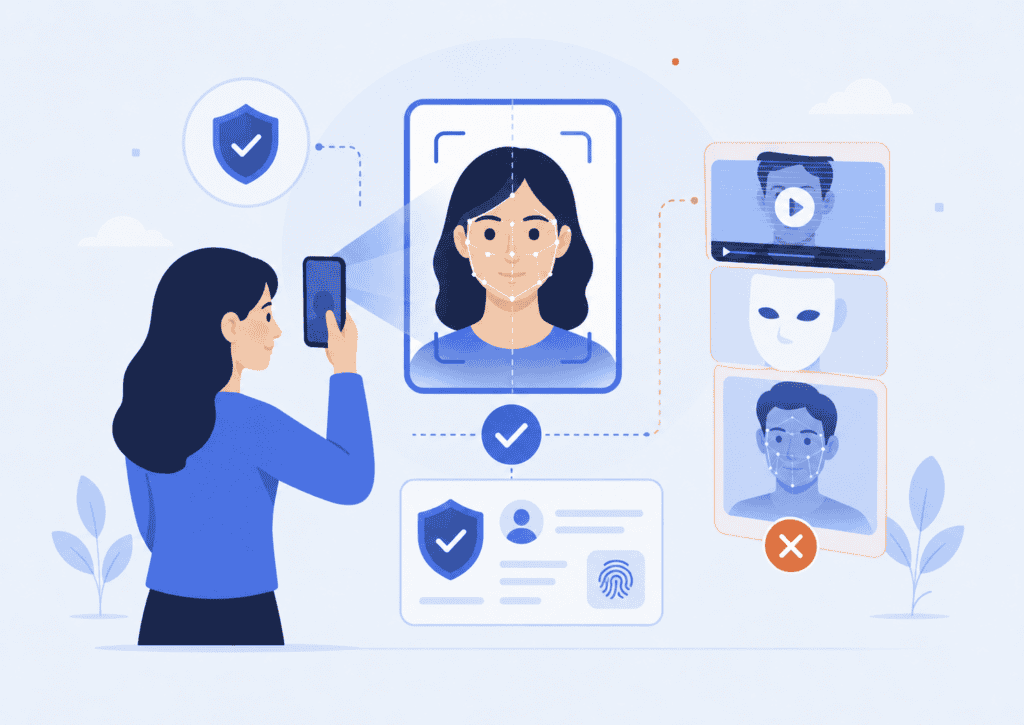
This is why binary decisions can be dangerous in high-stakes workflows. A better approach is tiered decisioning:
- Low risk: Media passes liveness, provenance, biometric, and device checks.
- Medium risk: One signal is weak, so the system asks for a new capture or extra verification.
- High risk: Multiple signals fail, so the session moves to manual review or rejection.
Deepfake identification also depends on context. A synthetic marketing image may not be a problem if it is labelled clearly. A synthetic face used to pass identity verification is a security threat. The same technology can be harmless, useful, or harmful depending on disclosure, consent, and use case.
The most reliable systems make that context visible. They show why a session was flagged instead of only returning “fake” or “real.” For example, a reviewer should know whether the concern came from facial texture, lip-sync mismatch, failed liveness, stripped provenance, or camera injection risk.
How to Evaluate Deepfake Detection Technology
Choosing deepfake detection tools is not just a model accuracy decision. You are choosing how your organisation will handle identity, privacy, false positives, and user trust.
Look for layered detection, not one signal
A strong system should combine forensic AI, liveness checks, biometric matching, device/session signals, and risk scoring. If a vendor only says “we detect deepfakes with AI” but cannot explain what signals are used, that is not enough.
Ask how the system handles:
- Face swaps.
- Fully synthetic faces.
- Replayed videos.
- Screen recordings.
- Camera injection.
- Voice cloning.
- Poor lighting and low-bandwidth video.
- Legitimate users with accessibility needs.
The answer should include both detection and fallback paths. If the system fails a user, what happens next? Does it request a recapture, step up authentication, or send the case to review?
Ask how the model is tested
Deepfake detection technology should be tested against current attacks, not only old public datasets. Deepfake generators change quickly. Fraud teams also adapt once they learn what a detector catches.
A practical test set should include realistic compression, device variation, demographic variation, lighting variation, and adversarial attempts. For identity systems, it should also include presentation attacks and injected media, not only edited videos.
NIST’s AI deepfake work highlights this challenge directly. Its GenAI deepfake challenge notes that modern tools can turn harvested photographs into highly realistic synthetic faces quickly, and that evaluation should include adversarial attacks while maintaining human-assessed realism. NIST’s GenAI deepfakes challenge is a useful reminder that easy samples do not prove real-world resilience.

Prioritise privacy-preserving architecture
Deepfake detection often involves sensitive biometric signals. That makes privacy architecture part of the product, not a side feature.
For high-trust workflows, consider whether the system can process signals on-device or at the edge, avoid storing raw images, and minimise the transfer of personally identifiable information. This matters for compliance, but it also matters for user confidence. People are more likely to complete verification when the process is clear, fast, and restrained in what it collects.
PrivateID’s broader identity platform focuses on on-device biometric processing, where no images or personal data need to leave the user’s device for core authentication flows. That architecture is especially relevant when deepfake detection sits alongside facial recognition, age assurance, or identity proofing.
Make the output usable for operations teams
A detector that returns a single confidence score may be useful for automation, but operations teams need more context. Reviewers should understand the reason for escalation and the recommended next step.
Useful outputs include:
- Risk level and confidence.
- Failed signal categories.
- Capture quality notes.
- Liveness result.
- Device or session anomaly flags.
- Recommended next action.
- Audit log for compliance review.
This is where many implementations succeed or fail. The model may be accurate, but if the workflow gives support teams no explanation, decisions become inconsistent.
Conclusion
Deepfake detection is best understood as a layered trust process, not a single AI filter. The strongest systems combine media forensics, liveness, provenance, biometric matching, and session context so businesses can make safer decisions without turning every user interaction into a manual investigation.
FAQs
What is deepfake detection in simple terms?
Deepfake detection is the process of checking whether an image, video, or audio clip has been created or manipulated using AI. It looks for technical signals such as unnatural motion, pixel artefacts, lip-sync mismatch, missing provenance, or failed liveness.
How does AI deepfake detection work?
AI deepfake detection works by training models to recognise patterns found in synthetic or manipulated media. These models may analyse faces, frame-to-frame motion, lighting, audio patterns, metadata, and capture behaviour to estimate whether the media is authentic or suspicious.
Are deepfake detection tools always accurate?
No. Deepfake detection tools can produce false positives and false negatives, especially when media is compressed, low quality, edited, or generated by newer models. That is why high-risk workflows should combine detection with liveness, biometric matching, device checks, and manual review.
What is the difference between liveness detection and deepfake detection?
Liveness detection checks whether a real person is physically present during authentication. Deepfake detection checks whether media appears synthetic or manipulated. They overlap, but they are not the same because a replayed real video may fail liveness even if it is not AI-generated.
Can metadata prove a video is real?
Metadata and Content Credentials can help show where media came from and how it was edited, but they do not prove authenticity in every case. Metadata can be removed or lost during re-uploading, cropping, screenshots, or platform processing, so it should be one signal among several.
Why does deepfake identification matter for age verification?
Age verification depends on trusting the submitted face, document, or session. If a minor uses a manipulated image, replayed video, or synthetic face, the age result may be unreliable. Deepfake identification helps protect age-restricted workflows from spoofing and impersonation.
What should businesses look for in deepfake detection technology?
Businesses should look for layered detection, current model testing, liveness support, privacy-preserving processing, clear audit logs, and practical escalation workflows. The best tool is not only accurate in a lab. It also works under real capture conditions and gives teams enough context to act safely.