
 Back
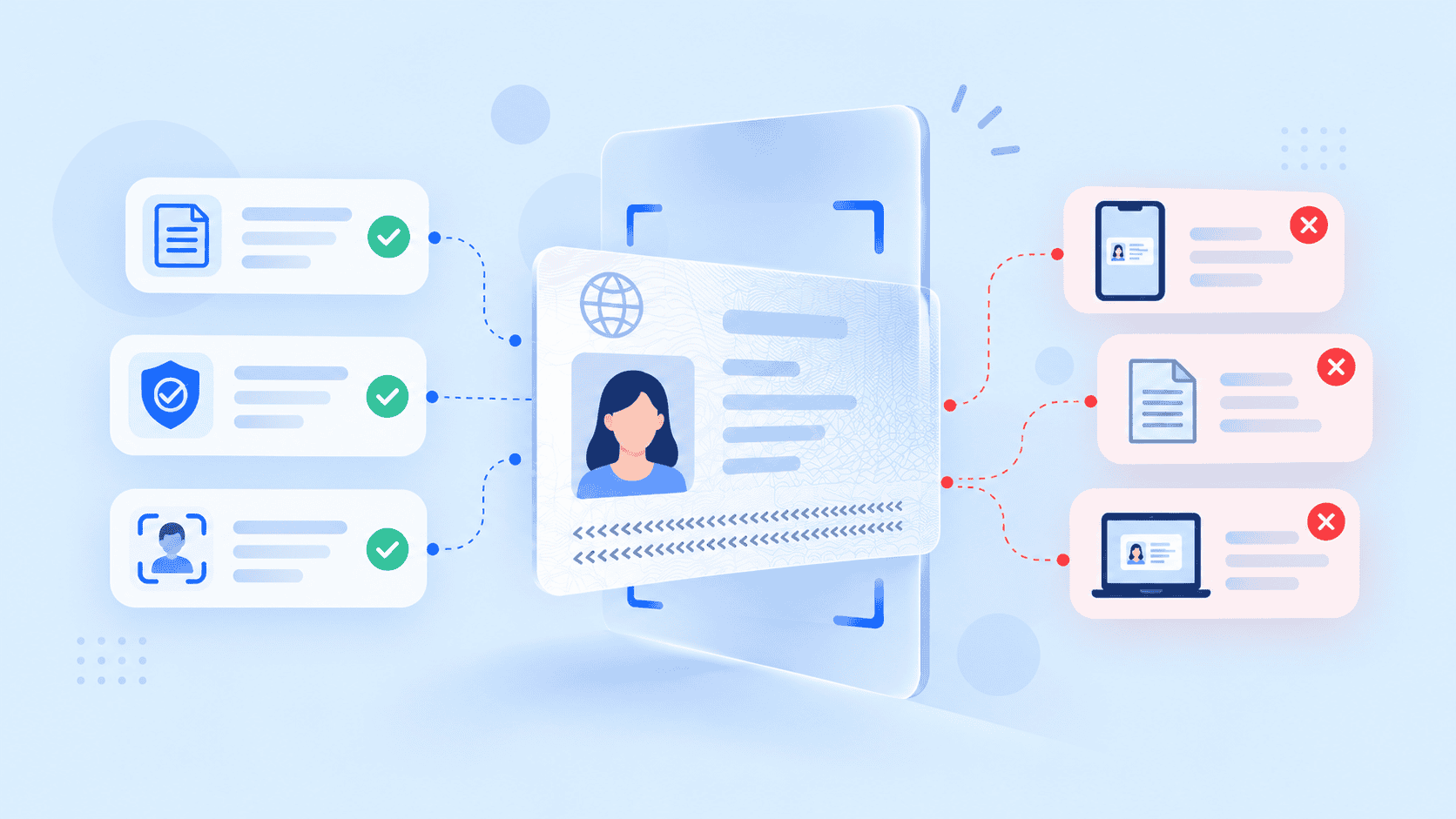
A convincing image of an ID is no longer enough to establish that the actual document was present during verification. Fraudsters can submit screenshots, photocopies, edited scans, screen replays, and increasingly realistic synthetic documents.
That is the problem document liveness detection software is designed to address. Instead of checking only whether an ID looks structurally correct, document liveness asks another question: Was a genuine physical document actually in front of the camera during capture?
This guide compares 10 document verification platforms with document-presence, authenticity, tampering, or presentation-attack capabilities. The list focuses on publicly documented functionality rather than a laboratory benchmark, so the right choice depends on the attack types, documents, deployment model, privacy requirements, and verification workflow your organization needs.
Key Takeaways
- Document liveness determines whether a physical identity document is genuinely present during capture rather than being submitted as a screenshot, scan, photocopy, or other reproduction.
- NIST SP 800-63A-4 includes live document capture and passive or active document-presence requirements for applicable automated remote evidence-validation processes.
- Document liveness is only one layer of document fraud detection. Stronger workflows also examine security features, data consistency, digital tampering, document validity, and NFC chip data where available.
- Vendors use different terminology. Some explicitly call the capability document liveness, while others incorporate similar controls into document authenticity, capture-integrity, or fraud-detection systems.
- Buyers should test software against their actual fraud cases instead of comparing vendors only by document-count claims or headline accuracy figures.
What Is Document Liveness Detection?
Document liveness is a real-time check designed to determine whether the identity document being captured is physically present in front of the camera.
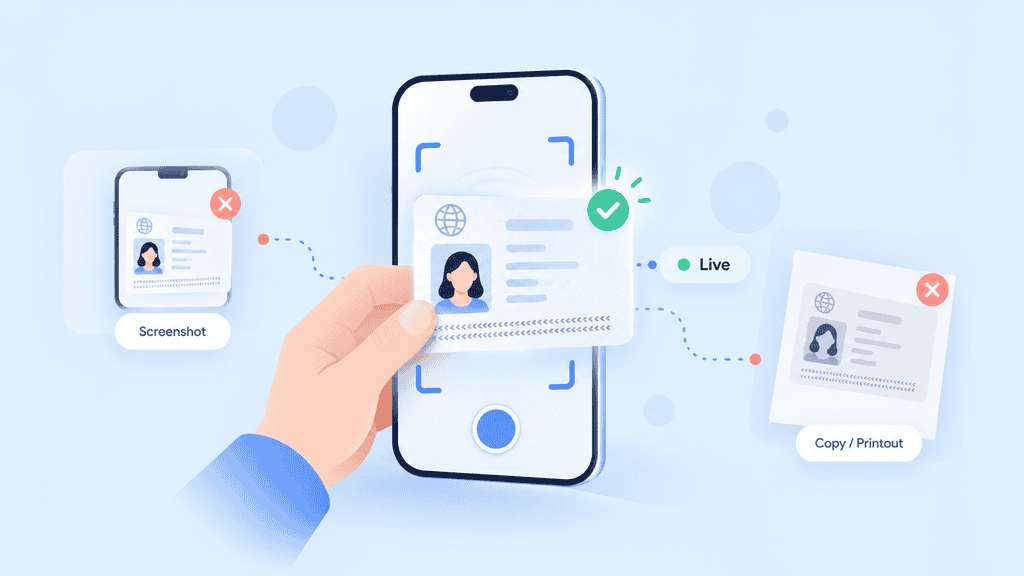
A live document is different from a valid-looking image of a document. Someone could display a stolen driver’s license on another phone, print a high-resolution reproduction, upload an altered scan, or inject a digitally generated document into the capture process.
Modern document liveness systems may analyze signals such as:
- Surface texture and depth cues
- Reflections and lighting behavior
- Screen artifacts
- Photocopy characteristics
- Document movement or capture sequence
- Hand presence
- Image metadata and digital manipulation
- Inconsistencies between visual, MRZ, barcode, and other document data
The importance of these checks is reflected in the NIST SP 800-63A-4 identity-proofing guidelines, which require live document capture and passive or active document-presence checks in specified remote identity-proofing workflows. These measures help establish that the document is physically present rather than a manipulated digital copy.
Document liveness therefore complements broader document verification technology, which may combine forensic authenticity checks, data extraction, face-to-ID matching, and authoritative-source verification.
How We Evaluated Document Liveness Detection Software
This comparison focuses specifically on software suitable for detecting document presentation and authenticity fraud, rather than ranking general KYC platforms by overall market size.
The strongest candidates provide several layers of protection.
Physical-presence detection: Can the system differentiate an original document from a screen, printout, photocopy, scan, or other reproduction?
Document tampering detection: Can it identify edited portraits, changed text, manipulated fields, synthetic documents, or structural inconsistencies?
Capture integrity: Does the platform help determine whether media originated through the expected camera workflow rather than being injected through a virtual camera, emulator, or modified capture channel?
Document authenticity verification: Does it examine security features, MRZs, barcodes, templates, NFC chips, or other document-specific evidence?
Developer deployment options: APIs, web SDKs, mobile SDKs, self-hosting, and configurable verification policies matter because document fraud controls need to fit the actual onboarding architecture.
User experience: A theoretically strong check has limited value if legitimate customers repeatedly fail because of glare, framing, camera quality, or confusing capture instructions.
An effective evaluation should examine these capabilities together. A document might pass a physical-presence check while still containing altered identity information. Likewise, a genuine ID may produce a false rejection because of poor capture conditions.
Top 10 Document Liveness Detection Software
1. PrivateID
Best for privacy-focused document and identity verification workflows
PrivateID combines document capture, automated document authenticity analysis, data extraction, selfie-to-ID matching, authoritative-source validation, and broader identity-proofing capabilities.
Its document verification system performs automated forensic checks intended to detect spoofed and counterfeit documents. The platform also supports on-device processing for elements such as data extraction and selfie-to-photo matching, giving privacy-sensitive organizations another architectural option when they do not want every identity signal handled centrally.
This makes PrivateID particularly relevant where document authenticity is only one part of a higher-assurance identity workflow.
A financial institution, for example, may capture an ID, check it for signs of counterfeit or manipulation, compare its information with authoritative sources, and verify that the person presenting it matches the portrait.
PrivateID also provides passive biometric liveness technology, which can complement document checks when the workflow needs to establish both that the evidence is trustworthy and that the rightful person is present.
Its passive liveness detection technology helps explain how facial presentation-attack detection can operate as an additional layer of identity verification.
Consider PrivateID if: Privacy architecture, document authenticity, biometric matching, and identity proofing need to work together instead of being purchased as isolated checks.
2. Microblink BlinkID Verify
Best for explicit, configurable document liveness checks
Microblink is one of the clearest examples of a provider treating document liveness as a dedicated verification category.
BlinkID Verify checks both document authenticity and liveness. Its documented DocumentLivenessCheck includes screen detection, photocopy detection, and an optional hand-presence check.
The broader verification system also examines image quality, data integrity, MRZ information, suspicious data, document validity, and other fraud indicators.
Microblink describes its document liveness technology as analyzing physical characteristics such as micro-texture, surface depth, and lighting interactions. It can return a configurable liveness score, allowing organizations to set thresholds according to their own risk tolerance.
That configurability is useful for organizations with several risk tiers. A low-value marketplace account might use one threshold, while a financial account opening or high-risk transaction could trigger stricter document requirements.
Consider Microblink if: You want document liveness exposed as a specific, configurable signal rather than hidden inside a single pass/fail authenticity decision.
3. Regula Document Reader SDK
Best for document-forensics depth
Regula’s Document Reader SDK combines document reading with extensive authenticity analysis. Its documented capabilities include document liveness detection intended to detect AI-generated images, screenshots, printouts, and IDs shown on electronic displays.
Regula’s broader approach is especially document-centric. Its product family covers document template recognition, visual inspection zones, MRZ analysis, barcode verification, electronic-chip validation, and forensic document examination.
That distinction matters. Some identity platforms are primarily designed around an onboarding journey and add document checks as one stage.
Regula has deep roots in the document-analysis layer itself, making it suitable for organizations that need granular document inspection or want document verification components inside their own application.
Consider Regula if: Document forensic analysis, international document coverage, and SDK-level integration are higher priorities than buying a fully managed KYC workflow.
4. Mitek
Best for established document-centric identity workflows
Mitek defines document liveness as confirming that a genuine identity document is being displayed in real time rather than a photograph, scan, or manipulated digital reproduction.
Its approach places document liveness inside a broader mobile identity-verification stack.
That is important because a document can fail for several independent reasons: it may be physically absent, digitally modified, structurally invalid, expired, or legitimately issued but presented by the wrong person.
A practical deployment therefore needs to connect presentation detection with document authenticity and identity ownership rather than treating liveness as a standalone fraud score.
Consider Mitek if: You need document liveness as part of an established mobile document-verification workflow, particularly for financial-services or regulated onboarding.
5. Innovatrics Digital Onboarding Toolkit
Best for teams wanting explicit document presentation-attack controls
Innovatrics provides a particularly concrete implementation of document liveness.
Its identity document verification technology is designed to determine whether the ID is physically present or displayed on another screen.
The platform documents screen-attack and print-attack detection, along with a configurable document-liveness threshold.
Innovatrics also supports OCR, MRZ validation, NFC document verification, portrait substitution checks, face matching, and biometric liveness.
That combination makes it possible to build a layered flow where different trust signals contribute independently to the final decision.
For example, an ID might successfully pass document liveness but still fail because the portrait appears replaced. Conversely, a structurally convincing document may fail because the system concludes that it is only being shown on another display.
Consider Innovatrics if: You want document liveness exposed alongside detailed document and biometric trust factors that can feed a configurable decision process.
6. Incode
Best for enterprise identity orchestration with document-liveness signals
Incode combines document verification, biometric checks, government-record matching, fraud signals, and workflow orchestration.
Its identity verification interface includes a screen-ID liveness result within document validation, while its broader platform incorporates document liveness alongside deepfake and injection-attack defenses.
That makes Incode more than a simple fake ID detection software tool. Organizations can combine the document result with facial recognition, user liveness, government validation, device intelligence, and risk rules.
This layered architecture is valuable because sophisticated fraud rarely produces only one suspicious signal.
An attacker may use a digitally manipulated document through an abnormal device environment while also presenting synthetic biometric media.
Correlating those signals can provide more context than a document-only decision.
Consider Incode if: You need document fraud detection software inside a larger enterprise identity, risk, and orchestration stack.
7. IDnow
Best for combining automated and agent-assisted verification
IDnow’s document identity verification offerings support automated document analysis through AutoIdent as well as agent-assisted verification through VideoIdent.
Its automated workflow includes document classification, data extraction, authenticity analysis, face comparison, and liveness checks.
The wider platform also supports visual verification, NFC verification options, and agent-assisted alternatives depending on workflow requirements.
IDnow does not always separate document liveness from the broader capture, authenticity, and user-liveness process in the same way Microblink or Innovatrics does.
Buyers evaluating IDnow specifically for document presence should therefore confirm exactly which screen-replay, photocopy, print, injection, and physical-presence checks are included in the proposed configuration.
Consider IDnow if: Regulatory workflows may need a mix of automation, electronic document verification, and human-assisted fallback.
8. Veriff
Best for globally distributed identity onboarding
Veriff combines assisted document capture, automatic document recognition, identity-document checks, passive user liveness, biometric analysis, and device or network signals.
Its platform supports a broad range of government-issued identity documents and applies fraud signals during the verification journey.
Veriff is therefore well suited to buyers who view document fraud as part of the overall identity session rather than as a standalone liveness API.
Because its public product material emphasizes comprehensive identity decisions more strongly than a separately configurable document-liveness score, organizations specifically combating screen-displayed IDs or photocopies should ask which document-presentation attacks are independently reported and how those signals appear in decision outputs.
Consider Veriff if: International onboarding coverage and combined document, biometric, device, and fraud analysis are major requirements.
9. Jumio
Best for end-to-end ID and selfie verification workflows
Jumio’s identity workflows combine government-ID validation, image checks, data checks, selfie verification, facial similarity, and biometric liveness.
Its developer documentation exposes these functions as configurable capabilities within verification workflows.
Jumio is stronger as a broad identity-verification platform than as a narrowly marketed document-liveness engine.
Organizations should therefore distinguish its user liveness capability from the document authenticity and image checks applied to the ID itself.
That distinction is essential during procurement.
A platform advertising liveness may mean it verifies that the person is live without necessarily giving the customer an independent document-liveness score.
Consider Jumio if: You need a complete ID-plus-selfie verification flow and can validate that its available document fraud checks cover the presentation attacks your threat model includes.
10. iDenfy
Best for combining automated verification with human review
iDenfy provides document verification, fraud checks, biometric liveness, AML screening, KYB capabilities, and human-supervised review within one platform.
Its product information describes passive verification designed to identify fake documents from a single image, alongside 3D biometric liveness used to resist user spoofing.
It also offers broad international document support.
As with several all-in-one providers, teams should avoid assuming that facial liveness and document liveness are interchangeable.
If screen replay, photocopy, printout, virtual-camera injection, or synthetic-document attacks are specifically causing losses, those attacks should become named test cases during the proof of concept.
Consider iDenfy if: You want identity verification and compliance tooling in one environment with automated checks backed by human review.
Document Liveness Detection Software Comparison
| Platform | Document Presence / Liveness Focus | Document Tampering & Authenticity | Biometrics / Face Match | Best Fit |
| PrivateID | Document spoof/counterfeit detection within authenticity workflow | Yes | Yes | Privacy-focused identity proofing |
| Microblink | Explicit screen, photocopy, and optional hand-presence checks | Yes | Yes | Configurable document liveness |
| Regula | Explicit document liveness and presentation-attack detection | Extensive | Available through broader stack | Deep document forensics |
| Mitek | Explicit document liveness | Yes | Yes | Mobile ID verification |
| Innovatrics | Explicit screen and print attack detection | Yes | Yes | Configurable document + biometric trust |
| Incode | Screen-ID liveness and document fraud signals | Yes | Yes | Enterprise orchestration |
| IDnow | Integrated into document-based IDV | Yes | Yes | Automated + agent-assisted verification |
| Veriff | Integrated fraud and session analysis | Yes | Yes | Global onboarding |
| Jumio | Document image checks plus separate user liveness | Yes | Yes | Full ID + selfie workflow |
| iDenfy | Passive fake-document checks plus biometric liveness | Yes | Yes | KYC with human-review fallback |
The table should be treated as a buying guide, not a laboratory ranking. Feature availability can differ by product tier, SDK, geography, document type, and workflow configuration.
How Document Liveness Differs From Tampering Detection
Document liveness and document tampering detection solve related but different problems.
Imagine a fraudster obtains a genuine photograph of a real driver’s license and displays it full-screen on a tablet during onboarding.
The information might be accurate. Nothing in the document image itself needs to have been edited.
A traditional authenticity system that only analyzes layout and text may therefore receive a visually plausible ID.
Document liveness looks for evidence that the physical credential is actually present.
Now consider a different attack. The fraudster has a genuine physical license but digitally replaces the portrait before submitting it.
That is a tampering problem rather than merely a presentation problem.
A strong document authenticity verification workflow needs to consider both.
The International Civil Aviation Organization’s Doc 9303 security specifications describe security features intended to protect machine-readable travel documents against copying, counterfeiting, fraudulent alteration, and other forms of document manipulation.
These requirements illustrate why identity document verification must examine multiple kinds of evidence rather than relying on visual appearance alone.
In practice, an effective document fraud stack may evaluate:
- Capture integrity: Did the media come through the intended camera channel?
- Document presence: Was a physical document actually in front of that camera?
- Document structure: Does it match the expected document type and version?
- Security features: Are expected visual, optical, or electronic characteristics present?
- Data integrity: Do printed fields, MRZ data, barcodes, and other sources agree?
- Digital manipulation: Are there signs of edited text, portraits, backgrounds, or synthetic generation?
- Validity: Is the document current and acceptable?
- Issuer validation: Can information be confirmed through an authoritative source?
- Ownership: Does the person presenting the evidence match the person to whom it was issued?
That is why document liveness should be viewed as one signal inside broader document fraud detection software, not as a replacement for document verification.
How to Choose the Right Document Liveness Detection Software
The best platform is not necessarily the one claiming the largest document database. Start with the fraud you actually need to detect.
Build a Real Presentation-Attack Test Set
A useful proof of concept should contain more than clean passports photographed under office lighting.
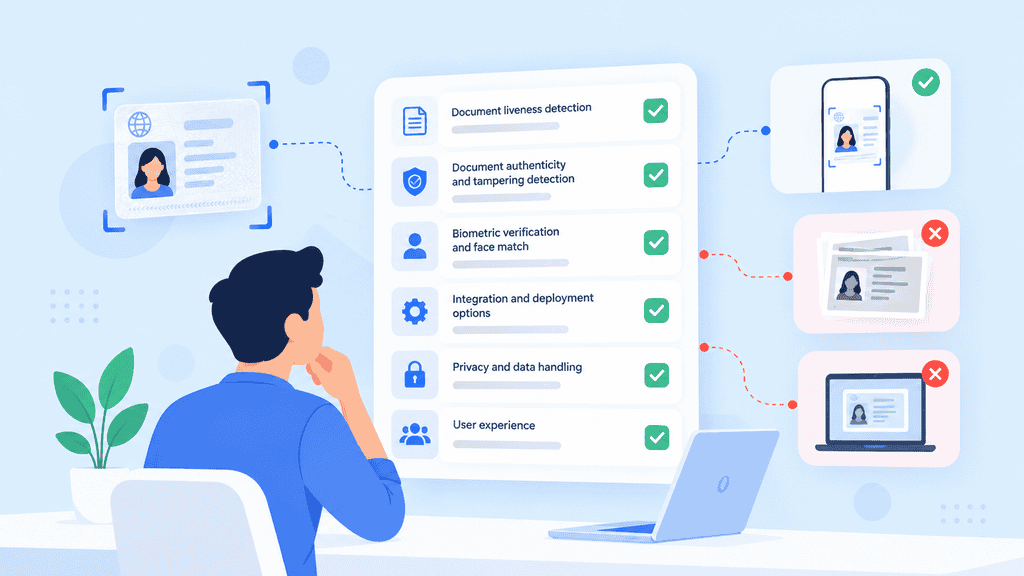
Create controlled test cases covering the attacks your business expects to encounter, for example:
- An original physical ID
- The same ID displayed on a phone
- The ID displayed on a laptop or tablet
- Color and grayscale photocopies
- A cropped printout
- A high-resolution scan
- An edited portrait
- Modified text fields
- Synthetic or generated ID imagery
- Glare and low-light captures
- Worn or damaged legitimate credentials
The goal is not simply to see which provider produces the most fraud decisions.
You also need to understand false rejects. Legitimate users will present scratched IDs, older cameras, unusual lighting, and imperfect captures.
Ask What Liveness Actually Means
This is one of the most important procurement questions.
If a vendor says its product includes liveness detection, ask whether that means:
- Facial liveness
- Document liveness
- Both
- Screen replay detection
- Photocopy detection
- Printout detection
- Camera-injection detection
- Virtual-camera detection
- Physical-security-feature analysis
A product with excellent facial presentation attack detection may still require a separate control to establish that the physical ID was present.
Evaluate the Entire Document Decision
A useful API response should explain why the document failed whenever possible.
A single opaque confidence score makes fraud operations harder.
More actionable results can distinguish between poor image quality, suspected photocopy, screen presentation, document expiration, inconsistent MRZ data, field manipulation, or unsupported document type.
This matters when designing fallback rules. A blurry capture should usually trigger a recapture. A likely digital forgery may need a very different response.
Check Whether NFC Fits Your Workflow
For electronic passports and compatible identity cards, NFC can add a stronger source of authenticity evidence by reading and cryptographically validating information stored on the chip.
It does not eliminate the need for every other document control, and NFC availability varies by credential and device.
But organizations handling supported electronic documents should ask vendors how optical checks, document liveness, NFC, and face matching work together.
Consider Privacy Before Deployment
Identity verification may involve passports, driver’s licenses, national IDs, extracted personal information, selfies, and biometrics.
Before integration, determine:
- What data is transmitted
- What stays on the device
- What is retained
- Retention duration
- Where data is processed
- Whether raw document images are necessary
- Whether sensitive fields can be masked
- How deletion works
- Which subprocessors participate
Privacy architecture becomes especially important when document verification is combined with biometric verification.
PrivateID, for example, offers on-device processing for parts of its identity flow, allowing organizations to consider a different model from workflows that routinely centralize raw biometric data.
Businesses evaluating these requirements can explore how a broader identity verification platform combines document checks, biometric matching, and configurable identity-proofing workflows.
Conclusion
The most useful document liveness detection software does more than decide whether an ID image looks real. It establishes confidence that a physical credential was genuinely present during capture, then combines that signal with document authenticity, tampering detection, data consistency, and identity ownership checks.
For procurement teams, the critical question is therefore not simply whether a vendor offers liveness detection.
Ask exactly what is live, which presentation attacks are detected, how those results are exposed, and how the system behaves against your own genuine and fraudulent documents.
FAQs
What is document liveness detection software?
Document liveness detection software evaluates whether a physical identity document is genuinely present during a live capture. It helps distinguish original documents from screenshots, screen replays, photocopies, scans, printouts, and other reproductions.
Is document liveness the same as facial liveness detection?
No. Facial liveness determines whether a real person is physically present rather than a photograph, mask, replay, or synthetic face. Document liveness evaluates the physical presence of the identity document. High-assurance onboarding may use both.
Can document liveness detect fake IDs?
It can detect some forms of fake ID presentation, particularly reproduced or digitally displayed documents, but it should not be the only fake ID detection software control. Counterfeit IDs may require template analysis, security-feature checks, tampering detection, barcode or MRZ validation, NFC verification, and authoritative-source checks.
What is the difference between document liveness and document authenticity verification?
Document liveness asks whether the physical document is actually present during capture. Document authenticity verification is broader and asks whether the document itself appears genuine and valid. A system may use liveness as one signal within a larger authenticity decision.
Can document fraud detection software identify digitally altered IDs?
Many platforms include document tampering detection designed to find modified text, replaced photographs, layout inconsistencies, synthetic elements, or conflicting data. Capability varies significantly between vendors, so altered documents should be included in pre-deployment testing.
Does NIST require document liveness?
NIST SP 800-63A-4 requires live document capture and passive or active document-presence checks for specified automated optical evidence-validation processes used in remote identity proofing. These requirements are not a blanket mandate for every identity-verification workflow.
What should businesses test before choosing a document liveness provider?
Test genuine documents and controlled fraud cases across the actual devices, lighting conditions, countries, and document types your customers use. Include screens, photocopies, printouts, altered images, poor-quality captures, and legitimate worn documents, then compare both fraud detection and false-rejection behavior.