
 Back
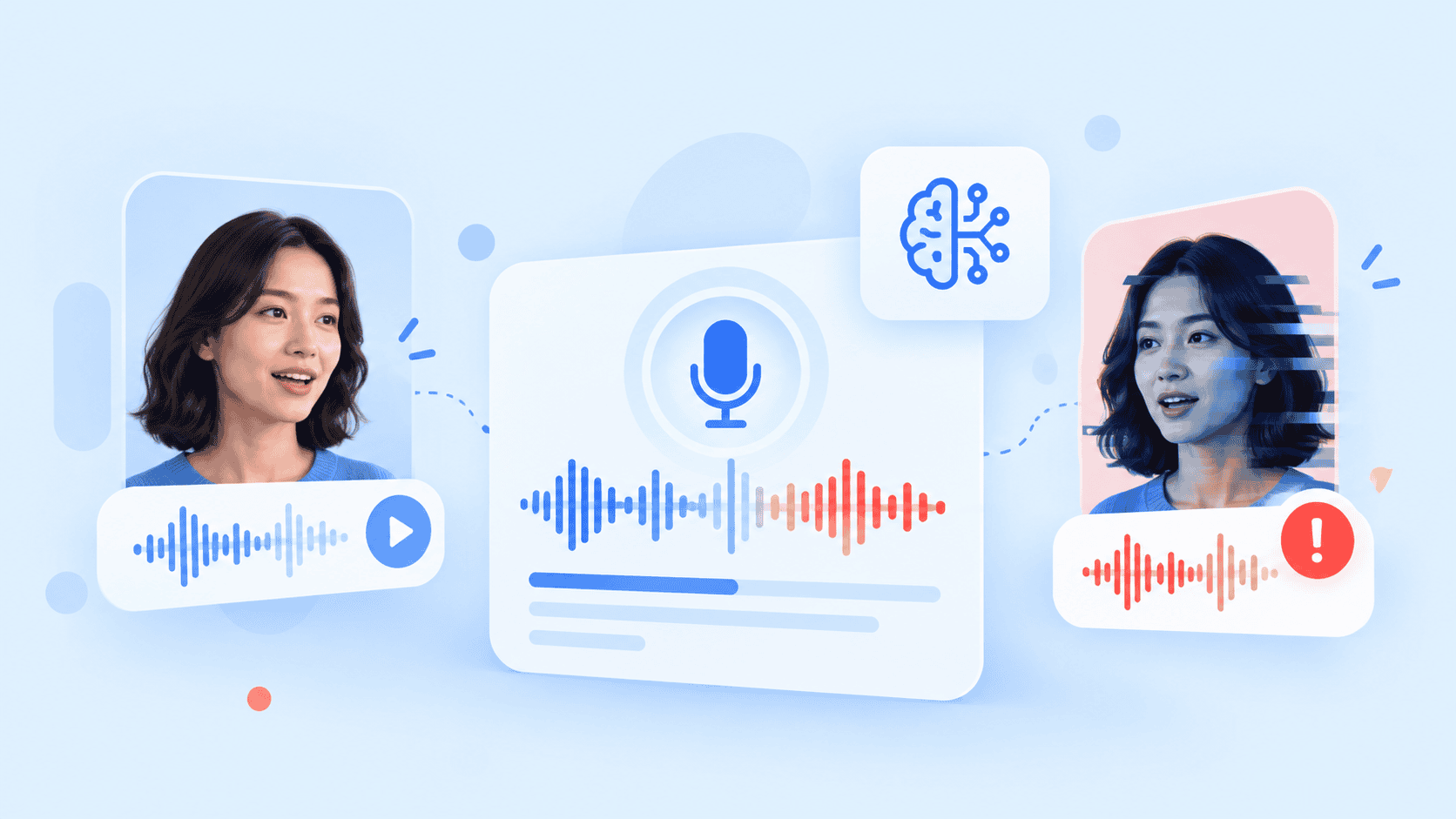
A voicemail from a CEO authorizing a payment can sound completely natural. So can a call from a family member asking for emergency money or a customer answering security questions in their own familiar voice. The problem is that none of those voices necessarily belong to the person they appear to represent.
Knowing how to detect deepfake audio now requires more than listening for a robotic accent. Modern voice-cloning systems can reproduce timing, tone, pronunciation, and speaker identity well enough that human hearing alone is an unreliable detector.
A better approach combines contextual verification, acoustic analysis, synthetic audio detection, and identity controls. This guide focuses specifically on audio and voice clones, rather than deepfake video or images, and explains what individuals and security teams can actually check when a recording or live call seems suspicious.
Key Takeaways
- Modern cloned voices can be convincing enough that listening alone should not be treated as proof of authenticity.
- Deepfake voice detection can examine spectral, temporal, phase, prosodic, and model-generated artifacts that listeners may not notice.
- Compression, telephone codecs, background noise, and previously unseen generation models can reduce detector accuracy.
- A suspicious voice should be verified through an independent trusted channel before money, credentials, access, or sensitive information is released.
- Organizations should combine synthetic audio detection with authentication, transaction controls, device and session signals, and human review.
What Is Deepfake Audio?
Deepfake audio is synthetic or manipulated sound created to imitate genuine human speech. In a voice-cloning attack, a model learns characteristics of a target speaker and generates new speech designed to sound as if that person said words they never actually spoke.
Different techniques can produce similar results.
Text-to-speech synthesis generates speech from written text and may reproduce the characteristics of a selected speaker.
Voice conversion takes speech from one person and transforms speaker characteristics so the result resembles another person while retaining much of the original linguistic content.
Speech editing or partial manipulation may alter only part of an otherwise authentic recording. A legitimate sentence, for example, could contain a synthetically inserted account number or payment instruction.
This distinction matters for audio deepfake identification. A detector that works well against one generator or a fully synthetic clip may behave differently when only a few words have been modified.
For a broader view covering manipulated images and video as well as audio, PrivateID’s guide to detecting deepfakes provides a useful companion resource. How to Detect a Deepfake: Tools, Techniques, and Warning Signs
The security implications go well beyond fake celebrity clips. The FBI has documented malicious campaigns involving AI-generated voice messages used to impersonate real officials and establish trust with targets.
How to Detect Deepfake Audio Step by Step
There is no single characteristic that proves a recording is synthetic. A reliable investigation works by collecting multiple signals and determining whether they tell a consistent story.
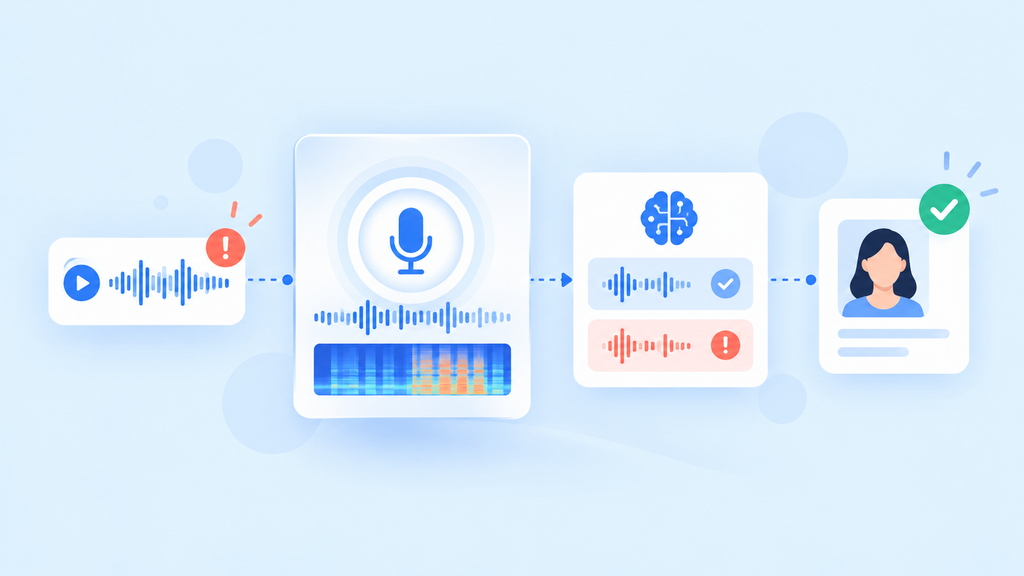
1. Preserve the best available copy
Start with the original audio whenever possible.
Forwarding a voice message between apps, screen-recording it, converting it to another format, or playing it through speakers and recording it again can introduce compression and acoustic artifacts. Those changes may destroy some of the signals an automated detector would otherwise examine.
Preserve:
- The original audio file
- File metadata
- The original message, email, or account that delivered it
- Timestamps
- Caller or sender details
- Surrounding conversation
- Any payment, login, secrecy, or urgency request associated with it
This contextual evidence matters because deepfake audio is often only one component of a social-engineering attack.
A technically convincing voice accompanied by an unexpected request to change a bank account should therefore become more suspicious, not less suspicious because the voice sounds familiar.
2. Listen for inconsistencies, but do not treat them as proof
Early synthetic speech was often identifiable through mechanical rhythm or poor pronunciation. Those clues are less dependable now, but careful listening can still reveal abnormalities.
Listen for:
- Unnatural pauses between words or phrases
- Changes in speaking rhythm
- Unusual pronunciation of names or specialized terms
- Emotion that does not match the conversation
- Sudden changes in volume or vocal quality
- Breaths appearing at unusual moments
- Missing or unnaturally regular breathing
- Abrupt transitions between words
- Background sound that changes unexpectedly
- Repeated speech patterns or unusually consistent delivery
Context is especially useful when you know the speaker.
Someone may have a recognizable cadence, vocabulary, accent, sense of humor, or way of addressing colleagues. A clone can reproduce vocal characteristics without necessarily reproducing the person’s habits or knowledge.
However, an absence of obvious mistakes proves nothing. The FTC notes that commercially available voice-cloning systems can create imitations that are difficult for people to identify by ear.
3. Check whether the audio file has been edited or reprocessed
Basic file inspection can sometimes reveal useful clues before specialized AI voice clone detection begins.
For example, ffprobe, included with FFmpeg, can display information about an audio file:
ffprobe -hide_banner suspicious-call.m4a
For more detailed metadata:
ffprobe -v quiet -print_format json -show_format -show_streams suspicious-call.m4a
Look at properties such as:
- Codec
- Sample rate
- Number of channels
- Bit rate
- Duration
- Creation or encoder metadata
Metadata cannot prove that speech is genuine. It may be missing, altered, or legitimately changed by a messaging service.
Its value is investigative.
Suppose someone claims a file is an untouched recording directly from a particular device, but its encoding information shows it has passed through editing software. That discrepancy deserves further investigation.
Tools such as Audacity and Sonic Visualiser can also be used to inspect the waveform and spectrogram.
4. Inspect the spectrogram for unusual patterns
A waveform shows amplitude over time. A spectrogram adds frequency information, allowing investigators to see how acoustic energy changes across the recording.
Synthetic speech systems can sometimes leave traces involving:
- Harmonic structure
- High-frequency energy
- Phase behavior
- Transitions between phonemes
- Spectral smoothness
- Voiced and unvoiced boundaries
- Repeated generation artifacts
This is not a matter of opening a spectrogram and looking for one universal “deepfake pattern.” Different models create different artifacts, while microphones, rooms, codecs, and transmission networks introduce their own signatures.
For example, ASVspoof evaluations specifically test countermeasures under conditions involving text-to-speech, voice conversion, telephone transmission, VoIP, and different codecs. That matters because a detector has to distinguish generation artifacts from ordinary channel artifacts.
Spectral analysis is therefore most useful as supporting forensic evidence, not as a standalone visual test.
5. Run a dedicated synthetic audio detector
Automated synthetic audio detection models look for statistical patterns associated with genuine and generated speech.
Depending on the system, the model may analyze raw audio or representations derived from it. Relevant characteristics can include:
- Spectral information
- Temporal dependencies
- Phase information
- Prosody
- Pitch behavior
- Voice quality
- Speaker embeddings
- Neural vocoder artifacts
- Differences between natural and generated acoustic structure
Research systems have used architectures including convolutional networks, graph-attention systems, self-supervised speech representations, and end-to-end models that work directly from waveforms.
The ASVspoof challenge has published reproducible baselines including LFCC-GMM, CQCC-GMM, LFCC-LCNN, and RawNet2, illustrating how different representations and architectures can be evaluated against bona fide and spoofed speech.
For enterprise investigations, the important question is not simply whether a vendor advertises “deepfake detection.” Determine whether the product has been tested against the kinds of audio your organization actually receives, including telephone speech, compressed recordings, live communications, and previously unseen generators.
PrivateID’s comparison of enterprise deepfake detection software discusses this broader evaluation problem across real-time and forensic use cases. Top 10 Deepfake Detection Tools for Enterprises
6. Compare results with context, not just a detector score
A detector returning an 80% or 95% probability of synthetic audio does not mean that the final security decision should automatically follow that score.
Ask a larger set of questions:
| Signal | Question to investigate |
| Audio detector | Does the recording contain characteristics associated with synthetic speech? |
| Speaker behavior | Does the language and conversational behavior make sense for this person? |
| Communication channel | Is this the person’s normal phone number, account, or device? |
| Request | Is the speaker asking for money, access, credentials, secrecy, or an unusual action? |
| Session history | Does the activity match previous legitimate behavior? |
| Independent verification | Can the person’s identity be confirmed elsewhere? |
This matters because false positives and false negatives are unavoidable.
NIST notes that synthetic audio detection performance can change based on the detection technique, dataset, preprocessing, generation method, background conditions, and whether the detector encounters generation systems it has not seen previously.
A detector should therefore contribute evidence to a decision rather than become the sole source of truth.
7. Verify the person through an independent channel
When the audio requests a sensitive action, independent verification is often more important than proving exactly how the audio was created.
Suppose a finance employee receives a voicemail:
“I’m about to enter a meeting. Send the $85,000 payment now and don’t call because I won’t be available.”
The employee does not need to conclusively identify the synthesis model before stopping the transaction.
Instead, the organization should use an independently established communication path, such as:
- Calling a previously verified phone number
- Using an authenticated corporate messaging account
- Requiring approval from another authorized employee
- Performing an established identity challenge
- Requiring strong authentication for the transaction
The key is to avoid using contact details supplied inside the suspicious message itself.
The FTC recommends exactly this type of out-of-band verification for suspected voice-cloning scams: contact the person using a phone number already known to belong to them rather than trusting the incoming communication.
How Synthetic Audio Detection Works
Modern deepfake voice detection is essentially a classification problem: given an audio sample, determine whether its characteristics are more consistent with bona fide human speech or synthetic/manipulated speech.
The difficulty lies in finding signals that continue to work as generation methods change.
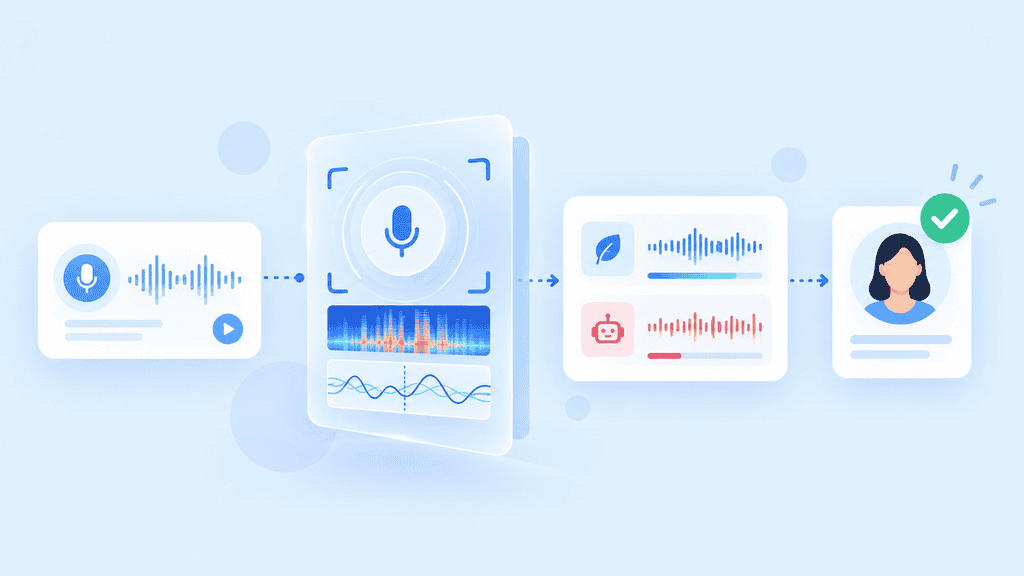
Acoustic and spectral analysis
Human speech is produced through a physical vocal system involving airflow, vocal-cord vibration, resonance, articulation, and continuously changing muscle movement.
A generative model reproduces the resulting audio statistically.
Although modern systems model speech extremely well, the generated signal may still contain subtle acoustic differences. Detection models can learn patterns in frequency content, harmonics, transitions, and other representations that separate training examples of real and synthetic speech.
Temporal analysis
Speech unfolds through time.
A detector may examine relationships across milliseconds, syllables, words, or an entire utterance. Synthetic systems can sometimes produce temporal patterns different from naturally spoken language, particularly around transitions or speech segments that are difficult to generate.
Temporal analysis also helps when a recording is only partly synthetic.
A ten-second recording might contain nine seconds of legitimate speech with one manipulated payment amount inserted into the middle. Segment-level analysis can be more useful in that situation than assigning a single score to the entire file.
Prosody and voice behavior
Prosody includes rhythm, stress, pitch, intonation, and timing.
Voice cloning models have become increasingly good at these properties, so awkward prosody should not be viewed as a dependable universal giveaway. However, acoustic models can analyze patterns at a resolution and scale that ordinary listening cannot.
The detector is not simply asking whether the voice “sounds weird.” It is measuring distributions of speech characteristics against patterns learned from genuine and manipulated examples.
Model and vocoder artifacts
Many speech-generation pipelines contain components responsible for turning an internal representation into an audible waveform.
Different synthesis techniques may leave characteristic statistical artifacts in the output. Detection systems can learn some of those artifacts.
The weakness is obvious: a detector that becomes highly dependent on artifacts from known generators may perform poorly when faced with a new architecture.
That is one reason modern research increasingly emphasizes generalization to unseen attacks rather than excellent results against only a fixed set of known generators.
ASVspoof 5, for example, was designed partly to evaluate stronger and more diverse attacks and to encourage countermeasures that continue working when spoofing techniques evolve.
Why Deepfake Voice Detection Is Difficult
If how to detect deepfake audio could be reduced to one acoustic signature, the problem would be much easier. Real-world audio removes that certainty.
Telephone and platform compression can hide useful evidence
A pristine WAV file and a voice note sent through multiple messaging systems are very different forensic inputs.
Audio may be:
- Downsampled
- Compressed
- Noise-suppressed
- Echo-cancelled
- Re-encoded
- Transmitted through VoIP
- Passed through a telephone codec
- Recorded from a speaker
These transformations can suppress generation artifacts while introducing new artifacts of their own.
A detector trained mainly on clean studio speech may therefore perform differently on a customer-service call.
Background noise affects both people and detectors
Real calls contain traffic, office conversations, fans, television audio, poor microphones, packet loss, overlapping speakers, and changing acoustics.
NIST specifically identifies background noise, multiple speakers, preprocessing differences, and unseen generation models as conditions that can degrade synthetic audio detection.
Security teams should test detectors with representative production audio rather than assuming benchmark accuracy transfers directly to their environment.
Detection and generation are both evolving
Every improvement in detection gives generation systems another obstacle to overcome.
A feature that reliably separated synthetic and human speech two years ago may become far less useful once newer generators reproduce it accurately.
The FTC describes this as an evolving technical problem and cautions that there is no single solution to the harms caused by voice cloning.
That makes detector maintenance important. Models, thresholds, evaluation datasets, and fraud workflows all need periodic reassessment.
A real person’s voice does not prove a real person’s presence
There is also a broader identity problem.
Even perfect speaker recognition would answer only one question: “Does this voice resemble the enrolled speaker?”
It would not necessarily establish that the speaker is genuinely present and intentionally authorizing the transaction.
A recording could be replayed. A voice could be converted. An account could be compromised. A legitimate recording could be edited.
This is why high-risk workflows should separate recognition from authentication and presence.
The same principle applies to visual biometric systems. Liveness detection is used to distinguish a real person present during capture from presentation attacks or manipulated media rather than relying only on whether a face resembles an enrolled identity.
How Organizations Should Handle Voice Fraud
Effective voice fraud detection should be designed as a workflow rather than purchased as a single classifier.
Consider a finance approval call.
An attacker obtains public recordings of an executive, creates a voice clone, calls accounts payable, and requests an urgent change to payment instructions. Even excellent synthetic audio detection may fail if the call is noisy or the generator is unfamiliar.
A stronger workflow creates several opportunities to stop the attack.
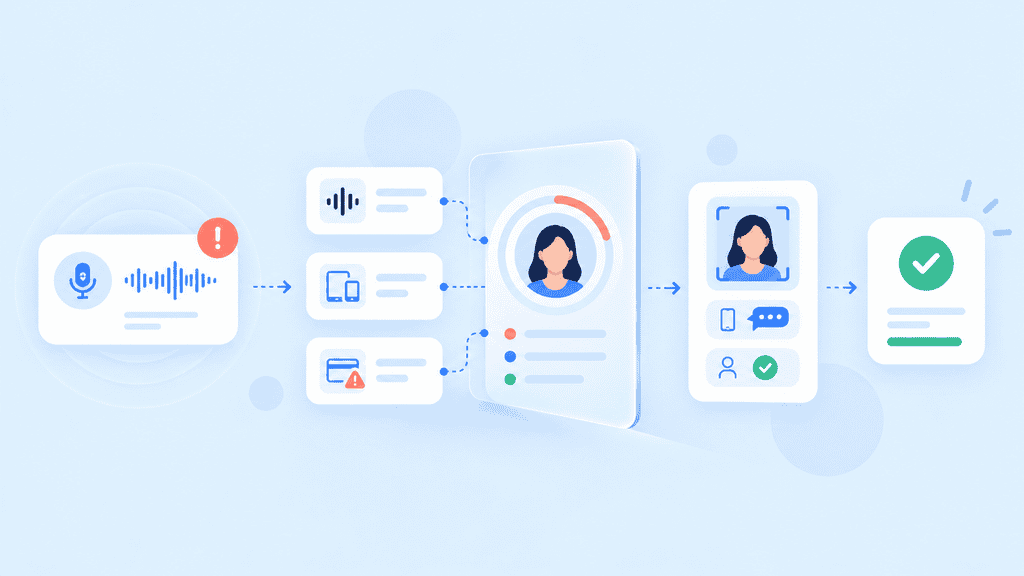
Use voice detection as a risk signal
A synthetic-audio score can help determine whether an interaction should continue, receive additional verification, or be escalated.
For example:
Low risk: Normal customer inquiry with consistent device and account history.
Elevated risk: Voice anomaly combined with a new device or unusual behavior.
High risk: Suspected synthetic audio combined with an urgent wire instruction or account-recovery request.
The action taken should reflect the consequence of being wrong.
Do not use voice alone for high-value authorization
Organizations should be cautious about workflows where recognizing a person’s voice is enough to authorize:
- Wire transfers
- Account recovery
- Password resets
- Changes to payment instructions
- Privileged administrative access
- Release of sensitive information
Use a separate authentication factor or an established approval channel.
This protects the organization even when the fake is too good for a human listener or detector to identify confidently.
Bind identity verification to the session
For remote identity workflows, the stronger question is not simply, “Does this sound like the user?”
It is:
Can we establish that the expected person is genuinely participating in this specific interaction?
That may require a combination of authentication, device/session evidence, identity verification, anti-spoofing controls, transaction context, and fraud monitoring.
NIST’s current digital identity guidance similarly calls for fraud management processes and analysis of remote identity-proofing channels for suspicious indicators rather than relying on a single fraud check.
Plan for uncertain results
Not every recording can be classified confidently.
Security procedures should therefore define what happens when the evidence is inconclusive.
Possible outcomes include:
- Allow
- Retry
- Step up authentication
- Request another channel
- Hold the transaction
- Send for manual review
- Block when multiple high-risk signals are present
The goal of AI voice clone detection is not to produce certainty where none exists. It is to add another meaningful signal to a well-designed fraud decision.
Conclusion
The most important lesson in learning how to detect deepfake audio is that authenticity should never depend on one clue.
Human hearing can miss a sophisticated voice clone. Automated detection can fail on new generators, compressed recordings, or noisy calls. File analysis can uncover anomalies without proving who created them.
The strongest defense combines those methods with something harder for an attacker to imitate: independently verified identity and authorization.
When a voice asks for access, money, credentials, or another sensitive action, the safest question is not simply, “Does this sound real?”
It is, “What independent evidence proves the person behind this interaction is who they claim to be?”
FAQs
Can you tell if audio is AI-generated just by listening?
Sometimes, but not reliably. Strange pacing, breathing, pronunciation, emotion, or background sound can raise suspicion, but modern voice clones can sound highly natural. Listening should be treated as an initial screening method rather than proof.
What is the best way to detect a deepfake voice?
The strongest approach combines automated synthetic audio detection with file and acoustic analysis, contextual fraud signals, and independent identity verification. No individual technique reliably detects every voice clone.
What does a deepfake audio detector look for?
Depending on the model, detectors can analyze spectral characteristics, timing, phase information, prosody, speech representations, waveform patterns, and artifacts associated with synthesis or voice-conversion systems. Different detectors use different combinations of these signals.
Can a spectrogram reveal AI-generated speech?
A spectrogram can reveal acoustic characteristics or suspicious transitions that support an investigation, but there is no universal visual pattern that proves speech is AI-generated. Spectrogram inspection is more useful when combined with specialized detection models and other evidence.
Can voice cloning fool voice authentication?
Voice cloning and replay attacks can create risks for systems that depend primarily on recognizing a speaker’s vocal characteristics. High-risk authentication should therefore use additional factors, anti-spoofing controls, session context, or independent verification rather than treating voice similarity alone as proof of presence.
Does compression make deepfake voice detection harder?
It can. Telephone codecs, VoIP, messaging platforms, noise suppression, re-encoding, and other processing can remove useful forensic signals or introduce unrelated artifacts. Detection systems should be evaluated using the same types of audio they will encounter in production.
What should I do if I receive a suspicious cloned-voice call?
Do not act on payment, credential, or sensitive-information requests immediately. End or pause the interaction and contact the supposed speaker through a phone number, account, or communication channel you already know is legitimate. For organizations, follow established fraud escalation and transaction-verification procedures.