Category: CATEGORY

  • A Closer Look at PrivateID UltraPass for Photo ID Capture

    A Closer Look at PrivateID UltraPass for Photo ID Capture

    Photo IDs remain one of the most widely trusted ways to verify identity, whether we are managing security in workplaces, issuing government credentials, onboarding students, or authenticating individuals across digital services. Expectations have evolved, and organizations now need Photo ID systems that are consistent, compliant, easy to use, and respectful of user privacy. PrivateID UltraPass brings a modern approach to this problem. It creates fully compliant ISO-ready portraits from any device, automatically checks dozens of photographic and biometric rules, and keeps all processing on the user’s device to preserve privacy. This article offers a closer look at how UltraPass works and why organizations are adopting automated, privacy-first Photo ID workflows.

    Key Takeaways

    • PrivateID UltraPass instantly generates ISO-compliant biometric photos from any camera-enabled device.
    • Automated checks reduce manual review and eliminate the need for supervised enrollment.
    • The system evaluates lighting, pose, facial visibility, geometry, and compliance in real time.
    • On-device processing means no images or personal data leave the user’s device.
    • UltraPass is used by governments, universities, enterprises, and law enforcement agencies.
    • Customizable rules match any credentialing standard and reduce photo rejections.
    • UltraPass integrates easily with PrivateID’s identity proofing, authentication, and liveness detection workflows.

    Why Photo IDs Still Matter

    A Photo ID is more than a picture, it is an important verification tool used across nearly every industry. Clear, compliant images help prevent fraud, speed up identity checks, and create consistency across large populations. The challenge is achieving accuracy and uniformity without relying on time-consuming manual steps. PrivateID UltraPass solves this by guiding the user through the capture process in real time and applying strict standards automatically.
    How PrivateID UltraPass Works

    How PrivateID UltraPass Works

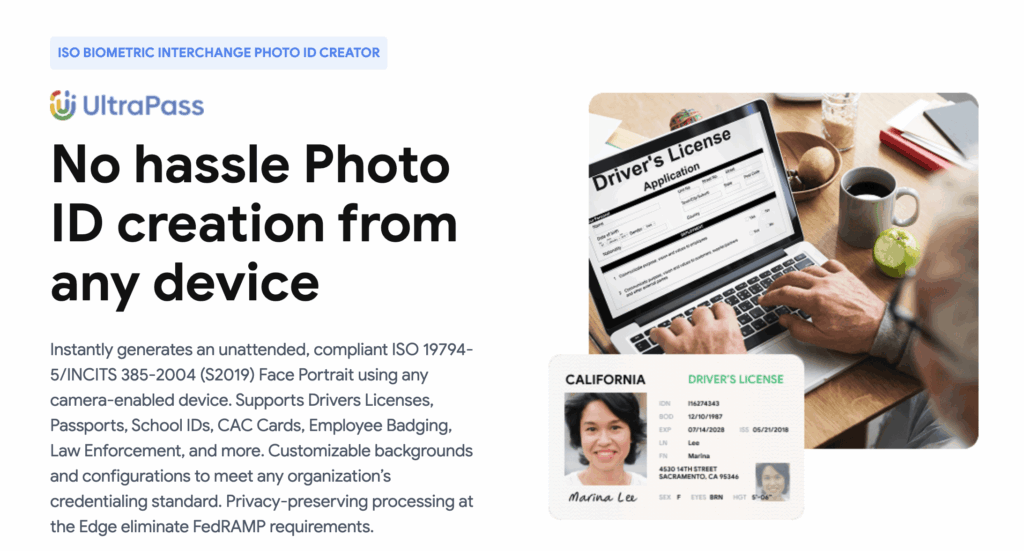
    UltraPass captures a fully compliant ISO 19794-5 and INCITS 385-2004 (S2019) biometric portrait from a phone, tablet, laptop, or desktop browser. The platform evaluates dozens of rules, including:

    • Illumination consistency
    • Facial symmetry and alignment
    • Eyes open and unobstructed
    • Background requirements
    • Smile or no-smile rules
    • Head size and position ratios
    • DPI and image dimensions
    • Liveness indicators

    PrivateID processes all of this locally on the device. No image, biometric template, or metadata is uploaded or stored remotely. This is a meaningful advantage for organizations that want modern identity workflows without taking on biometric privacy risk.

    Where Organizations Use UltraPass

    Government and Public Identity Programs

    UltraPass streamlines credential issuance for driver’s licenses, passports, visas, residency cards, and CAC access cards.

    Education

    Universities and schools use the platform to collect uniform student and staff photos without requiring in-person appointments.

    Corporate and Workforce ID Programs

    Enterprises rely on UltraPass to produce employee badges, contractor passes, and visitor credentials with consistent quality.

    Law Enforcement and Military

    Agencies use UltraPass for mugshots, booking photos, and field intake where strict standards must be met with no manual adjustment.

    Online Account and Profile Images

    Any organization needing highly consistent user photos can use UltraPass to enforce uniform standards at scale.

    Customizable Rules for Any Standard

    Every organization has its own requirements for acceptable images. UltraPass allows administrators to set their exact rules, covering everything from lighting thresholds to biometric ratios. This flexibility reduces retakes and accelerates approval because the system automatically enforces those rules during capture. Common configurable options include:

    • Background color and brightness
    • Required illumination levels
    • Head size, symmetry, and centering
    • Eye axis and separation ratios
    • DPI and resolution
    • Teeth visibility
    • Glasses detection
    • Pose rules
    • Liveness detection settings

    This ensures the Photo ID output matches the organization’s official standard every time.

    Privacy and Speed: UltraPass Advantages

    Privacy through on-device processing

    Since PrivateID analyzes images directly on the device, organizations avoid:

    • Storing biometric images
    • Transmitting sensitive data
    • Meeting FedRAMP or similar infrastructure requirements
    • Managing biometric privacy compliance risk

    This is a major improvement over traditional server-based systems.

    Faster, smoother experience

    UltraPass guides users in real time. The result is fewer rejected photos, fewer help requests, and a shorter time to completion. Combined with PrivateID’s identity proofing and authentication platform, it becomes part of a complete end-to-end system that stays fast and secure at scale.

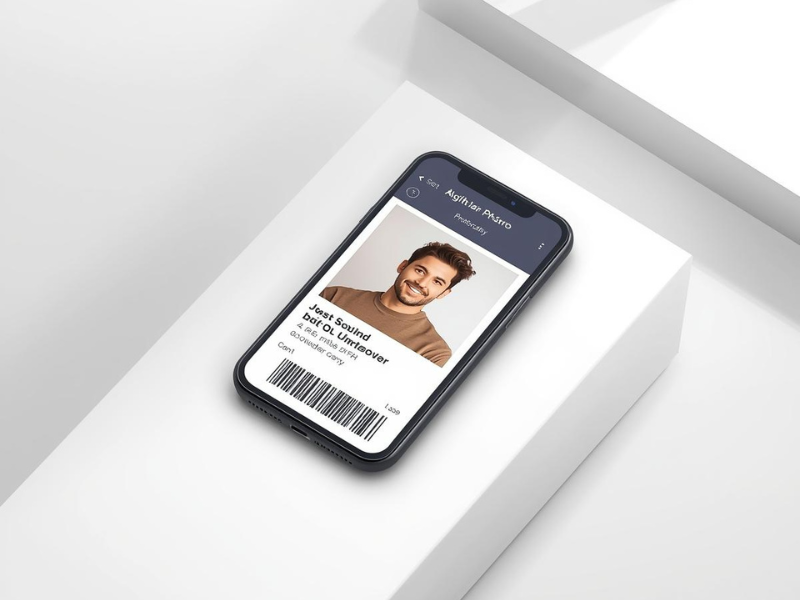
    Best Practices for High-Quality Photo IDs

    Even with advanced automation, strong operational practices make the system more effective.

    • Use simple, clean backgrounds for user-captured photos.
    • Provide short instructions to help users position themselves correctly.
    • Maintain consistent lighting standards where possible.
    • Use templates or preset rules for uniform design.
    • Implement clear distribution and deactivation policies for issued IDs.

    These practices help create a predictable, high-quality identity experience.
    Best Practices for High-Quality UltraPass Photo IDs

    How UltraPass Fits Into PrivateID’s Identity Ecosystem

    UltraPass can stand alone or extend into PrivateID’s broader identity platform. Organizations often pair it with:

    • On-device liveness detection
    • Deepfake detection
    • Document verification
    • On-device PII extraction
    • KYC and AML workflows
    • Passwordless authentication
    • Privacy-preserving biometric matching

    This gives institutions flexible ways to modernize identity verification without keeping biometric data centrally stored.

    Conclusion

    Photo ID creation has evolved far beyond manual photo capture and human review. PrivateID UltraPass automates the entire process, generates compliant biometric images from any device, and protects user privacy through on-device processing. When combined with strong internal standards and consistent workflows, UltraPass helps organizations create secure, modern, and scalable identity systems.

    Frequently Asked Questions About PrivateID UltraPass Photo ID Capture

    How does PrivateID UltraPass ensure that every submitted photo is compliant with ISO and organizational standards?

    UltraPass evaluates each image in real time against a long list of biometric and photographic criteria specified in ISO 19794-5 and INCITS 385-2004. This includes illumination, background uniformity, symmetry, head position, eye openness, facial visibility, occlusions, and geometric ratios. If a photo falls outside the acceptable thresholds, the system prompts the user with immediate corrections, preventing low-quality submissions before they enter the review pipeline. Because these checks operate entirely on the user’s device, organizations get consistent, compliant output without relying on manual review or controlled photo stations.

    2. What makes on-device processing such a major advantage for privacy and compliance?

    Traditional Photo ID capture tools upload images to remote servers for processing, which automatically triggers biometric privacy obligations, data retention requirements, and breach exposure. UltraPass flips this model by performing all processing locally on the user’s device. No image is transmitted, stored, or logged, which significantly reduces regulatory burden. It also eliminates the need for specialized environments like FedRAMP and removes the organization from legal exposure tied to biometric storage. This approach allows institutions to modernize identity workflows while avoiding privacy risks entirely.

    Can UltraPass support high-volume programs, such as government credentialing or large university enrollments?

    Yes. The platform is designed for scale. Because UltraPass automates validation directly during capture, the number of rejected submissions drops sharply, and administrators avoid time-consuming manual review. Users can complete the process remotely at their own pace, which reduces congestion during enrollment periods. Organizations can also configure rules centrally and deploy them to thousands or millions of users without changing hardware or infrastructure. The net effect is lower operational load, faster throughput, and more predictable quality at scale.

    4. How customizable are the rules for Photo ID capture?

    UltraPass allows organizations to mirror their exact photographic and biometric policies. Administrators can adjust background hue, illumination levels, head size and centering ratios, DPI, eye axis and separation, smile rules, glasses detection, and more than twenty additional parameters. These rules can match international standards, government regulations, internal branding guidelines, or agency-specific requirements. Once configured, the system automatically enforces them during capture, ensuring every photo meets internal expectations without staff intervention.

    5. How does UltraPass fit into a broader identity verification or authentication workflow?

    UltraPass can operate as a standalone Photo ID capture tool or as part of PrivateID’s wider identity ecosystem. Many organizations extend it with on-device liveness detection, deepfake detection, document verification, and privacy-preserving biometric authentication. PrivateID’s SDKs allow easy integration into onboarding portals, workforce management systems, government licensing workflows, or access control platforms. Because everything is processed on the device, organizations gain the benefits of a unified identity proofing process without inheriting the storage risks associated with traditional biometric platforms.
  • Age Assurance in Digital Spaces and Why It Matters

    Age Assurance in Digital Spaces and Why It Matters

    We spend more of our lives online than ever before, engaging, shopping, gaming, socializing, and learning through the endless opportunities of the digital world. But as these experiences become more immersive and widespread, ensuring that users are the appropriate age for various digital interactions takes center stage, for both ethical responsibility and legal compliance. That’s where age assurance steps in: a dynamic set of strategies and technologies designed to verify and validate a user’s age in the digital environment. Our ability to trust the online experiences we create and interact with depends on the effectiveness and sophistication of these mechanisms. Let’s break down why age assurance matters, explore the tools that drive it, and look at how it’s shaping safer digital spaces for everyone.

    Key Takeaways

    • Age assurance is essential for ensuring that users meet age requirements online, balancing legal compliance and ethical responsibility.
    • Technology-driven age assurance methods include ID verification, biometrics, and AI-powered algorithms for both accuracy and privacy.
    • Global regulations like COPPA, GDPR, and the UK Children’s Code drive companies to implement robust age assurance systems.
    • Businesses must overcome challenges in privacy, inclusivity, and accuracy to deploy effective age assurance across digital environments.
    • Innovations such as privacy-first verification and cross-platform digital credentials are shaping the future of age assurance.
    • Adopting rigorous and empathetic age assurance builds trust, enhances user safety, and prepares organizations for evolving online standards.

    Understanding Age Assurance: Definition and Importance

    At its core, age assurance refers to the collection of processes and tools used to determine or validate a user’s age online. Unlike traditional, face-to-face age checks (think showing an ID at a bar), digital environments demand solutions that are fast, secure, user-friendly, and privacy-aware. Age assurance covers a spectrum from robust age verification, relying on credentials or documents, to subtler assurance methods that estimate age based on behavioral or statistical analysis.

    Why is this such a critical concern? Many digital services and platforms host content or enable interactions that are age-restricted for good reason: to protect children’s privacy, prevent access to inappropriate material, and comply with international law. Effective age assurance helps companies demonstrate responsible stewardship, reduce legal exposure, and build trust with users and regulators alike.

    Understanding Age Assurance Definition and Importance

    Key Methods of Age Assurance

    Technological Solutions for Age Verification

    Technology continues to propel age verification to new heights. The most direct approaches include scanning government-issued IDs, using biometric analysis such as facial recognition, or leveraging digital identity wallets. These digital verification tools often employ artificial intelligence and machine learning to cross-check uploaded documents for authenticity or match facial features against provided photographs. Some services integrate with third-party databases, such as credit reference agencies, to corroborate age claims without requiring users to share too much personal data upfront.

    There’s another path as well: device-based verification. Here, unique device identifiers or SIM registration data may be cross-referenced to deduce a likely age profile, especially on mobile-first platforms. The flexibility and layering of these technologies not only bolster accuracy but help platforms select the best solution for their audience and risk level.

    Behavioral and Data-Based Approaches

    Not every online interaction justifies full-blown ID checks. For low-risk services or early-stage engagement, behavioral and data-based approaches come into play. Age estimation algorithms might analyze how users interact with a website or app, their language patterns, or the way they complete onboarding forms. Sometimes, age is inferred from information already held by a service (like purchase history or account tenure) or through cross-service data flows, all while maintaining privacy safeguards.

    These approaches require careful calibration to avoid overreach or bias. Yet, implemented thoughtfully, they contribute to a seamless user experience and powerful risk mitigation, allowing businesses to strike an ideal balance between diligence and digital freedom.

    Regulatory Landscape and Compliance Requirements

    The march toward a safer digital world is driven in part by evolving legal and regulatory demands placed on organizations. Compliance isn’t just a box to tick, it’s a complex and dynamic mandate shaping how age assurance needs to be structured globally.

    Major Global Regulations Impacting Age Assurance

    Key regulations that are reshaping the digital landscape include:

    • Children’s Online Privacy Protection Act (COPPA) in the United States: Requires verifiable parental consent before collecting data from children under 13 and sets strict rules for age checks.
    • General Data Protection Regulation (GDPR) in the European Union: Establishes a minimum age for digital consent (typically 16, with national adjustments) and rigorous data protection standards for all online interactions.
    • UK Age Appropriate Design Code (Children’s Code): Forces platforms likely to be accessed by children to default to privacy and safety-first design, demanding robust age assurance.
    • Australia’s Online Safety Act and similar legislations elsewhere: Mandate risk-based age controls, transparency, and accountability from technology providers.

    Organizations that serve global audiences face the intricate challenge of aligning with overlapping and sometimes conflicting requirements. Effective age assurance is hence not only a technical matter but a strategic legal and operational commitment.

    Challenges in Implementing Age Assurance Systems

    Even as our age assurance tools grow more sophisticated, they’re not without hurdles. Companies of all sizes face a suite of technical, ethical, and operational challenges as they roll out and refine their systems.

    Balancing User Privacy and Security

    Perhaps the thorniest challenge is delivering trustworthy age checks without crossing privacy boundaries. Users are justifiably cautious about sharing highly personal information like government-issued IDs or biometric data for basic online access. At the same time, weak verification risks exposing young users to harm. So we need to develop nuanced processes, such as zero-knowledge proofs or encrypted anonymized checks, that minimize unnecessary data exposure while still providing high-confidence results.

    Accuracy and Inclusivity Concerns

    No age assurance solution is infallible. Errors can allow underage access or, conversely, block legitimate users, especially those lacking formal ID (like refugees or the elderly). Algorithms trained on biased datasets can further exacerbate exclusion or misidentification. To advance both inclusivity and security, ongoing investment in testing, dataset diversity, and user feedback is crucial. Companies striving for broad adoption must design systems that account for edge cases while continually improving accuracy.

    Applications Across Industries

    The need for age assurance spans virtually every corner of the digital economy, but two segments are pushing innovation at breakneck speed.

    Social Media and Online Platforms

    Social networks, video-sharing sites, and forums face intense pressure to protect minors from inappropriate content and interactions. Robust age assurance mechanisms help these platforms comply with global regulations and signal to parents and guardians that child safety isn’t an afterthought. Some platforms now use a mix of AI-driven moderation, ID verification at account creation, and ongoing behavioral checks to minimize risk without upending user experience.

    E-Commerce and Online Gaming

    Online retailers selling age-restricted goods, think alcohol, tobacco, or adult content, must both prevent underage sales and provide smooth, convenient purchasing. Here, seamless age checks can reduce cart abandonment while fulfilling legal requirements. In gaming, age gating protects minors from unsuitable games, restricts communication features, and limits in-game purchases. The challenge is making these checks invisible for adults yet frictionless for everyone, which demands continual technological refinement.

    The Future of Age Assurance Technology

    The Future of Age Assurance Technology

    If the last few years are any evidence, age assurance technology is on the brink of even more exciting leaps.

    Emerging Trends and Innovations

    • Privacy-First Verification: Technologies like blockchain digital ID wallets and zero-knowledge proofs are set to transform age assurance by proving a user’s eligibility without disclosing underlying personal info.
    • AI and Continuous Risk Monitoring: Smart algorithms are evolving to blend static (one-time) checks with ongoing behavioral analysis, picking up signs of account sharing or misuse in real time.
    • Cross-Platform Interoperability: Universal digital credentials, where a single trustworthy age claim is accepted by multiple services, are gaining traction and could eliminate today’s fragmented verification experiences.
    • Regulatory Tech (RegTech): Automated and intelligent systems built to keep up with fast-changing regulations help organizations remain compliant across jurisdictions with minimal manual oversight.

    We’re likely to see even deeper collaboration between technology providers, businesses, regulators, and civil society as the stakes, and the innovation curve, keep rising.

    Conclusion

    Age assurance will define the next decade of online safety, trust, and legal compliance. While the technology matures rapidly, our commitment as digital citizens and builders must match pace: Championing solutions that respect privacy, defend inclusion, and deliver confidence to users of all ages. The future is vibrant for those who put rigorous, empathetic, and transparent age assurance at the heart of their digital offerings, and we’re ready to help lead the way.

    Frequently Asked Questions About Age Assurance

    What is age assurance and why is it important online?

    Age assurance refers to processes and technologies that determine and validate a user’s age in digital environments. It’s crucial for protecting children, complying with regulations, and ensuring that users have appropriate online experiences without exposing them to harm or privacy risks.

    How is age assurance different from traditional age verification?

    Age assurance in digital settings uses fast, secure, and privacy-focused methods, such as AI algorithms or digital ID verification, instead of in-person ID checks. It covers a range of solutions, from robust document checks to behavioral analysis, offering flexibility based on the risk and context of the online service.

    What are the main technologies used for age assurance?

    Technologies for age assurance include scanning government IDs, facial recognition, biometric analysis, device-based checks, digital identity wallets, and age estimation algorithms. These solutions often blend artificial intelligence and privacy-preserving methods to validate a user’s claimed age efficiently and securely.

    Why do global regulations impact how companies implement age assurance?

    Global regulations like GDPR, COPPA, and the UK Children’s Code require digital platforms to protect minors, seek verified consent, and implement proper age checks. Companies must align with these often overlapping laws to avoid penalties, maintain user trust, and operate internationally.

    Can age assurance systems affect user privacy?

    Yes, poorly designed age assurance systems can threaten privacy if they collect excessive personal or biometric data. Modern solutions aim to minimize data collection by using encrypted checks or zero-knowledge proofs, balancing trust in age verification with strong privacy protections.

    Which industries benefit most from effective age assurance solutions?

    Industries such as social media, online gaming, and e-commerce—especially those offering age-restricted goods or services—benefit strongly from robust age assurance. These measures help platforms comply with laws, protect young users, and build safer, more trustworthy digital experiences.

  • Deepfake Detection and the New Reality of Digital Proof

    Deepfake Detection and the New Reality of Digital Proof

    Few topics spark as much curiosity and concern as deepfakes. These hyper realistic digital fabrications have moved far beyond novelty, influencing public opinion, enabling fraud, and eroding trust in digital media. As creators, security leaders, and technologists, we face a growing responsibility to understand how deepfakes work and how to detect them reliably at scale.

    In this guide, we break down how deepfakes are created, why detection matters, the technologies used to identify them, and where the future of deepfake detection is heading.

    Key Takeaways

    • Deepfake detection is critical for combating misinformation, financial fraud, and identity abuse
    • Machine learning, biometric analysis, and multi modal detection are core to modern defense strategies
    • Combining automated detection with human review improves accuracy and reduces false positives
    • Detection systems must adapt rapidly as deepfake generation techniques evolve
    • Real time, privacy preserving detection is emerging as the next frontier

    Understanding Deepfakes and Their Impact

    Deepfakes are synthetic media generated using artificial intelligence to convincingly replicate real people in audio, video, or images. These fabrications often appear authentic to the human eye and ear, making them particularly dangerous.

    The impact extends across industries:

    • Fake executive voices used in financial fraud
    • Manipulated videos influencing elections or public discourse
    • Synthetic identities enabling large scale identity theft
    • Harassment and non consensual media targeting individuals

    As deepfakes become easier to create, organizations that fail to detect them face reputational damage, regulatory exposure, and financial loss.

    Understanding Deepfakes and Their Impact with Deepfake Detection

    How Deepfakes Are Created

    Most deepfakes are produced using Generative Adversarial Networks. These systems rely on two neural networks competing against each other.

    The process typically includes:

    • Collecting large datasets of real audio or video
    • Training models to replicate facial movements, speech patterns, and expressions
    • Refining outputs until the fake becomes difficult to distinguish from reality

    Open source tools and consumer apps have dramatically lowered the barrier to entry, making deepfake creation accessible to non experts.

    Why Detecting Deepfakes Matters

    Deepfake detection is not optional anymore. It is foundational to digital trust.

    Key risks include:

    • Misinformation and reputation damage
    • Executive impersonation and payment fraud
    • Synthetic identity creation at scale
    • Erosion of trust in legitimate digital evidence

    In regulated industries such as finance, healthcare, and media, failure to detect deepfakes can have legal and operational consequences.

    Core Technologies Used in Deepfake Detection

    Machine Learning Based Detection

    Machine learning models are trained on vast datasets of real and manipulated media to identify subtle anomalies.

    Common techniques include:

    • Convolutional Neural Networks for image and video analysis
    • Temporal analysis to detect inconsistencies across video frames
    • Audio signal analysis to identify synthetic speech artifacts

    These systems operate at scale and detect patterns invisible to humans.

    Forensic and Biometric Analysis

    Forensic techniques add scientific rigor and context.

    These include:

    • Pixel and compression artifact analysis
    • Metadata validation and provenance checks
    • Biometric signals such as blink rates, speech cadence, or micro expressions

    Modern detection platforms increasingly combine biometric signals with AI analysis to improve confidence.

    This is where solutions like PrivateID’s MediaSafe facial biometric tracking and deepfake detection become relevant. MediaSafe analyzes live video streams using privacy preserving biometric signals to identify manipulated or synthetic faces in real time, without storing or transmitting biometric images.

    Human and Automated Detection Working Together

    Neither humans nor machines are sufficient alone.

    • Automated systems provide speed, scale, and consistency
    • Human reviewers contribute contextual judgment and intent analysis

    The most effective detection pipelines use AI to flag high risk content, followed by expert human review for validation.

    Current Challenges in Deepfake Detection

    Despite progress, detection faces ongoing challenges:

    • Rapid evolution of generation techniques
    • Generalization issues when models encounter new deepfake types
    • Adversarial attacks designed to bypass detectors
    • High computational requirements for real time analysis

    Detection is an arms race, requiring continuous learning and adaptation.

    Emerging Trends and Research Directions

    Innovation in deepfake detection is accelerating.

    Key developments include:

    • Multi modal fusion combining audio, video, and metadata
    • Explainable AI to support legal and regulatory review
    • Blockchain based provenance tracking
    • Edge based detection for real time video streams

    Privacy preserving approaches are also gaining importance. On device processing and anonymized biometric analysis reduce risk while maintaining accuracy, an approach already reflected in PrivateID’s architecture.

    Legal, Ethical, and Social Considerations in Deepfake Detection

    Legal, Ethical, and Social Considerations

    Detection is not purely technical.

    Key considerations include:

    • Balancing security with privacy rights
    • Avoiding overreach or surveillance abuse
    • Preserving free expression while limiting harm
    • Establishing accountability for misuse

    Clear standards and transparent detection practices are essential to maintain public trust.

    The Future of Deepfake Detection

    Looking ahead, effective detection will be:

    • Real time rather than reactive
    • Integrated directly into media platforms and identity workflows
    • Supported by global standards and collaboration
    • Privacy preserving by design

    As deepfakes grow more sophisticated, detection must evolve just as quickly, without compromising civil liberties or data protection.

    Conclusion

    Deepfakes represent one of the most complex challenges of the modern digital era. Detecting them requires a blend of advanced technology, human judgment, ethical frameworks, and cross industry cooperation.

    By investing in scalable, privacy conscious detection systems and educating users, we can protect trust in digital media and ensure innovation continues responsibly.

    Frequently Asked Questions About Deepfake Detection

    What is deepfake detection and why is it important?

    Deepfake detection involves identifying digitally manipulated audio, video, or images created using AI. Detecting deepfakes is crucial because they can spread misinformation, enable fraud, erode public trust, and harm reputations and privacy across society.

    What are the main challenges in deepfake detection?

    Challenges include the rapid evolution of deepfake technology, a lack of diverse training data, adversarial attacks specifically engineered to fool detection systems, and the high computational resources required for accurate identification.

    Can humans reliably detect deepfakes without automated tools?

    While humans can sometimes spot contextual oddities or behavioral cues, highly sophisticated deepfakes are often indistinguishable without automated tools. The best systems combine machine analysis and expert human review for maximum accuracy.

    What are emerging trends in deepfake detection technology?

    Emerging trends include real-time detection using edge AI, blockchain-based verification for digital provenance, explainable AI for transparency, multi-modal fusion combining several data types, and crowdsourced reporting to enhance detection efforts.

    How can individuals protect themselves from deepfake scams?

    Individuals should verify content from trusted sources, be cautious with unsolicited communications, use reputable fact-checking tools, and stay informed about deepfake detection developments to avoid falling victim to scams and misinformation.

  • Biometric Authentication and Its Role in Modern Digital Security

    Biometric Authentication and Its Role in Modern Digital Security

    Biometric authentication has moved from novelty to necessity. What once felt futuristic is now embedded in everyday life, from unlocking smartphones to authorizing financial transactions and securing sensitive systems. As digital interactions accelerate and traditional passwords prove increasingly fragile, biometric authentication offers a more resilient path forward. By relying on unique biological and behavioral traits, it reshapes how trust and access are established in modern security environments.

    Understanding how biometric authentication works, where it excels, and where it requires careful implementation is essential for organizations and individuals navigating today’s threat landscape. This guide explores the technology, its benefits, its limitations, and where biometric authentication is headed next.

    Key Takeaways

    • Biometric authentication uses unique physiological and behavioral traits to verify identity securely and efficiently.
    • Common methods include fingerprints, facial recognition, iris scanning, voice recognition, and behavioral biometrics.
    • Biometric systems improve security and user experience but must address spoofing, accuracy, and privacy risks.
    • Protecting biometric data through encryption and privacy focused design is critical.
    • Future developments emphasize continuous authentication, AI driven improvements, and stronger privacy safeguards.
    Understanding Biometric Authentication

    Understanding Biometric Authentication

    Biometric authentication is the process of verifying identity using characteristics intrinsic to an individual rather than knowledge or possessions. Unlike passwords, PINs, or access cards, biometric traits cannot be easily forgotten, shared, or reused across systems.

    Physiological biometrics such as fingerprints or facial features rely on stable physical characteristics. Behavioral biometrics, such as typing patterns or movement, analyze how a person interacts with devices and environments. Together, these methods provide a powerful alternative to traditional authentication approaches that are increasingly vulnerable to phishing, credential stuffing, and data breaches.

    As organizations seek both stronger security and smoother user experiences, biometric authentication fills a critical gap. It allows access decisions to be made quickly and confidently, without placing the burden of password management on users.

    Modern biometric authentication platforms, such as PrivateID, are increasingly designed around privacy-preserving architectures. Rather than transmitting or storing biometric images centrally, PrivateID processes biometric data entirely on the user’s device, ensuring that no facial images or biometric templates ever leave the device. This approach significantly reduces breach risk while aligning with global privacy regulations and emerging best practices for biometric security.

    Types of Biometric Authentication Methods

    Biometric authentication methods fall into two broad categories, each serving different security and usability needs.

    Physiological Biometrics

    Physiological biometrics are based on measurable physical traits that remain relatively stable over time.

    • Fingerprint recognition remains one of the most widely deployed biometric methods due to its balance of accuracy, cost, and ease of use.
    • Facial recognition enables contactless authentication by analyzing facial structure and features using cameras and algorithms.
    • Iris and retinal scanning offer extremely high accuracy by examining unique patterns in the eye, often reserved for high security environments.
    • Voice recognition identifies individuals by vocal characteristics and is commonly used in call centers and remote verification.
    • Hand geometry and vein recognition provide alternatives in environments where fingerprints or facial scans are impractical.

    These methods are often combined to improve reliability and reduce the risk of false matches.

    Behavioral Biometrics

    • Behavioral biometrics focus on how a person behaves rather than how they look.
    • Keystroke dynamics analyze typing rhythm, speed, and pressure to create a behavioral profile.
    • Gait analysis evaluates walking patterns and movement.
    • Mouse movement and touchscreen behavior are used silently in the background to identify anomalies.
    • Signature recognition remains relevant in certain regulated industries.

    Behavioral biometrics are particularly valuable for continuous authentication, monitoring activity after initial login to detect suspicious behavior.

    How Biometric Authentication Works

    Behind the simplicity of biometric authentication lies a structured and highly technical process.

    Enrollment and Verification

    The process begins with enrollment. A biometric sample is captured and converted into a digital template using specialized algorithms. This template represents key features rather than raw biometric data and is stored securely, often encrypted or kept locally on a device.

    During verification, a new biometric sample is captured and compared to the stored template. If the similarity score meets a predefined threshold, access is granted. This threshold must be carefully calibrated to balance security and usability, minimizing both false acceptances and false rejections.

    Modern systems often supplement biometric matching with additional signals such as device trust, environmental factors, or contextual risk scoring. For example, PrivateID’s on-device biometric authentication performs identity confirmation in approximately 25 milliseconds, demonstrating how speed and privacy can coexist without compromising security.

    Benefits of Biometric Authentication

    The rapid adoption of biometric authentication is driven by several compelling advantages.

    • Security is significantly enhanced because biometric traits are difficult to replicate or steal at scale.
    • User convenience improves as authentication becomes faster and more intuitive.
    • User experience benefits from reduced friction and fewer interruptions during login or verification.
    • Fraud prevention strengthens when access is tied directly to an individual rather than shared credentials.
    • Scalability allows biometric systems to be deployed across millions of users and devices with consistent performance.

    These benefits make biometric authentication particularly attractive in banking, healthcare, government services, and enterprise environments.

    Challenges and Limitations of Biometric Systems

    Despite its strengths, biometric authentication is not without challenges.

    Spoofing and Attack Vectors

    Attackers have demonstrated methods such as fake fingerprints, high resolution understanding of facial recognition systems, and voice deepfakes. To counter this, many platforms incorporate liveness detection to verify that a real person is present during authentication.

    Accuracy and Environmental Factors

    Biometric performance can be affected by lighting conditions, camera quality, physical injury, aging, or background noise. Systems must be designed to handle real world variability without penalizing legitimate users.

    Device and Infrastructure Dependency

    Not all devices support the same biometric sensors, which can limit universal adoption. Organizations must plan for fallback authentication methods to ensure accessibility.

    Addressing these challenges requires continuous model updates, testing, and thoughtful system design.

    Privacy and Security Considerations

    Biometric data is inherently sensitive. Unlike passwords, biometric traits cannot be replaced if compromised.

    • Strong encryption and access controls are essential to protect biometric templates.
    • Decentralized or on device processing reduces exposure by avoiding centralized biometric databases.
    • Clear data retention policies and transparency help maintain user trust.
    • Compliance with privacy regulations such as GDPR and CCPA is mandatory in many regions.
    • Layering biometric authentication with additional security measures, such as device trust or contextual verification, further reduces risk.

    Platforms that eliminate centralized biometric storage reduce regulatory exposure and long-term risk. PrivateID’s architecture avoids transmitting or storing biometric data entirely, helping organizations meet requirements under GDPR, CCPA, BIPA, and healthcare or financial regulations without introducing new attack surfaces.

    Biometric Authentication Privacy and Security Considerations

    Future Trends in Biometric Authentication

    Biometric authentication continues to evolve alongside advances in artificial intelligence and privacy technology.

    • Continuous authentication will monitor behavior throughout a session rather than relying on a single login event.
    • Wearable and embedded sensors will extend biometric authentication beyond phones and laptops.
    • AI driven models will improve accuracy while adapting to new attack techniques.
    • Privacy preserving approaches such as on device processing and user controlled credentials will become standard.
    • Global standardization efforts will improve interoperability across borders and industries.

    These developments point toward biometric systems that are both more secure and more respectful of individual privacy.

    Conclusion

    Biometric authentication has become a cornerstone of modern digital security. By replacing fragile credentials with identity based verification, it enables stronger protection and smoother experiences across countless use cases. Its success, however, depends on careful implementation, continuous improvement, and an unwavering commitment to privacy.

    As organizations embrace biometric authentication, the goal should not be convenience alone, but trust. When designed responsibly, biometric systems help create a digital environment where access is secure, friction is minimized, and users remain in control.

    Frequently Asked Questions About Biometric Authentication

    What is biometric authentication and how does it work?

    Biometric authentication is a security process that verifies identity using unique biological or behavioral traits, such as fingerprints or facial structure. It involves capturing a biometric sample, generating a digital template, and comparing it with a stored record to grant or deny access.

    What are common types of biometric authentication methods?

    The main types of biometric authentication include physiological methods (fingerprint, facial recognition, iris scans) and behavioral methods (keystroke dynamics, gait analysis). Each has distinct applications and strengths in enhancing security and user experience.

    What are the main benefits of using biometric authentication?

    Biometric authentication offers enhanced security, unmatched convenience, improved user experience, and reduced fraud. As these methods are tied to unique characteristics, they make unauthorized access and identity theft much more difficult compared to traditional authentication methods.

    Are there any privacy risks with biometric authentication systems?

    Yes, biometric data is highly sensitive. If compromised, it cannot be replaced like a password. Organizations must secure biometric templates with strong encryption, limit access, and comply with privacy laws to protect user data and maintain public trust.

    How is biometric authentication evolving in the future?

    Biometric authentication is advancing with continuous authentication, wearable sensors, and artificial intelligence integration. Future trends focus on privacy-first approaches, on-device processing, and global standardization to offer more secure and seamless experiences.

    Can biometric authentication be combined with other security measures?

    Absolutely. Combining biometrics with PINs, tokens, or device checks—known as multifactor authentication—provides layered protection and helps prevent breaches from a single point of failure.

  • Effective Identity Verification Strategies for Building Digital Trust

    Effective Identity Verification Strategies for Building Digital Trust

    Trust is the foundation of every meaningful digital interaction. Whether someone is opening a bank account, accessing healthcare services, onboarding as an employee, or verifying their identity remotely, confidence in who is on the other side of the screen matters. As more of our lives move online, identity verification has become a critical safeguard not only against fraud, but also for preserving trust between individuals, businesses, and institutions.

    Modern identity verification is no longer about ticking compliance boxes. It is about enabling secure access without unnecessary friction, protecting personal data while meeting regulatory obligations, and creating experiences that feel reliable rather than intrusive. This guide explores what identity verification really is, why it matters, how it works today, and how organizations can approach it strategically as threats and expectations continue to evolve.

    Key Takeaways

    • Identity verification is essential for preventing fraud and enabling trust in digital interactions
    • Effective verification combines documents, biometrics, and automation for layered assurance
    • Security, privacy, and user experience must be balanced to maintain adoption and compliance
    • Regulatory requirements shape verification strategies across industries
    • Future-proof identity verification relies on privacy-first architectures and adaptive technologies

    What Is Identity Verification?

    Identity verification is the process of confirming that an individual is who they claim to be before granting access to services, systems, or sensitive information. In practice, this means validating identity attributes against trusted sources using a combination of documents, data checks, and biometric signals.

    This process plays a central role in everything from financial onboarding and healthcare access to remote work and digital government services. Without strong identity verification, organizations are exposed to impersonation, account takeover, and regulatory risk.

    As digital interactions have accelerated, identity verification has evolved far beyond manual checks. Today’s systems combine traditional identity proofing with advanced automation and biometric verification, enabling organizations to establish trust remotely while maintaining high levels of accuracy and speed.

    What Is Identity Verification

    Why Identity Verification Matters

    Identity verification is not just a security control. It is a trust mechanism.

    When identity verification is done well, it reassures users that their information is protected and that the organization they are interacting with takes security seriously. When done poorly, it creates friction, abandonment, and reputational damage.

    Key reasons identity verification is essential include:

    Fraud Prevention

    Verifying identities early and accurately reduces the risk of impersonation, synthetic identity fraud, and unauthorized access. As fraud techniques become more sophisticated, especially with AI-generated content, layered verification is no longer optional.

    Regulatory Compliance

    Industries such as finance, healthcare, and workforce management are subject to strict identity assurance requirements. Regulations like KYC, AML, GDPR, CCPA, and sector-specific standards mandate how identities are verified, stored, and protected.

    Business Enablement

    Strong identity verification enables faster onboarding, remote access, and global reach. Organizations that can verify users confidently without manual delays gain a competitive advantage.

    Trust and Reputation

    Security failures tied to weak identity verification can permanently damage trust. A single breach often carries long-term consequences that extend beyond immediate financial loss.

    Common Identity Verification Methods

    Effective identity verification relies on multiple complementary techniques. No single method is sufficient on its own, especially in high-risk or regulated environments.

    Document-Based Verification

    Document verification involves validating government-issued credentials such as passports, national IDs, or driver’s licenses. Modern systems analyze both visible and hidden security features, check for signs of tampering, and validate data consistency.

    Many workflows pair document verification with a live selfie or biometric comparison to ensure the document belongs to the person presenting it. This approach is commonly used in onboarding, credential issuance, and compliance-driven verification.

    This is also where document verification solutions offered by PrivateID are commonly applied within broader identity proofing workflows.

    Biometric Verification

    Biometric verification uses unique physical characteristics such as facial features, fingerprints, voice patterns, or iris scans to confirm identity. Biometrics offer strong assurance and convenience, especially when implemented on personal devices.

    However, biometric systems must be designed carefully to address privacy risks. Centralized storage of biometric templates increases exposure, while privacy-preserving, on-device biometric processing significantly reduces risk.

    PrivateID’s approach to biometric verification processes biometric data entirely on the user’s device, ensuring that biometric templates never leave the device or enter centralized databases.

    Knowledge-Based Authentication

    Knowledge-based authentication relies on information the user is expected to know, such as passwords, security questions, or one-time codes. While still used in some contexts, these methods are increasingly vulnerable due to data breaches and social engineering.

    As a result, knowledge-based methods are often being phased out or supplemented with stronger biometric and cryptographic controls.

    Automated and AI-Driven Verification

    Automation has transformed identity verification at scale. Machine learning models can assess documents, detect anomalies, validate identities in real time, and flag suspicious behavior with greater consistency than manual review.

    When paired with liveness detection, automated systems can distinguish real users from photos, videos, or deepfakes, significantly reducing spoofing risk while improving user experience.

    Challenges in Identity Verification

    Despite technological advances, identity verification remains a complex challenge.

    Evolving Fraud Techniques

    Attackers now use synthetic identities, deepfake videos, and automated bots to bypass traditional controls. Verification systems must continuously adapt to new threat vectors.

    Privacy and Data Protection

    Users are increasingly sensitive to how their personal data is handled. Over-collection, centralized storage, or unclear data practices can erode trust and create regulatory exposure.

    User Experience Friction

    Lengthy or confusing verification processes increase abandonment rates. Security that feels punitive or invasive undermines trust rather than building it.

    Inclusion and Accessibility

    Not all users have access to the same documents or devices. Verification systems must accommodate diverse populations without lowering security standards.

    Regulatory and Compliance Considerations for Identity Verification

    Regulatory and Compliance Considerations

    Identity verification strategies are shaped by global and industry-specific regulations.

    Global Standards

    Frameworks such as GDPR, CCPA, and NIST 800-63 define how identities must be verified, protected, and audited. These standards influence everything from data retention policies to acceptable assurance levels.

    Industry-Specific Requirements

    Financial services must meet KYC and AML obligations. Healthcare organizations must protect patient identities under HIPAA. Workforce and government systems often require higher identity assurance levels such as IAL2 and AAL2.

    Providers like PrivateID that are certified under Kantara and aligned with NIST 800-63 help organizations meet these requirements without compromising privacy.

    Best Practices for Effective Identity Verification

    Organizations that succeed in identity verification follow a few consistent principles.

    Match Assurance to Risk

    Not every interaction requires the same level of verification. Tailor verification depth to the sensitivity of the transaction.

    Prioritize Privacy by Design

    Minimize data collection, avoid centralized biometric storage, and ensure transparency in how identity data is processed.

    Optimize for User Experience

    Clear instructions, mobile-friendly workflows, and fast verification times reduce friction and abandonment.

    Choose Future-Ready Partners

    Select identity providers that demonstrate regulatory alignment, strong security architecture, and the ability to evolve with emerging threats.

    The Future of Identity Verification

    Identity verification is entering a new phase defined by privacy-preserving technologies and decentralized models.

    Trends shaping the future include decentralized digital identities, verifiable credentials, on-device biometric authentication, and zero-knowledge proofs. These approaches allow individuals to prove identity attributes without exposing unnecessary personal data.

    At the same time, organizations must remain vigilant as fraud techniques continue to evolve. Continuous improvement, cross-industry collaboration, and adaptive security models will define the next generation of trusted digital identity systems.

    Conclusion

    Identity verification is no longer just a defensive measure. It is a strategic capability that enables trust, access, and growth in a digital-first world. By combining strong verification methods with privacy-first design and thoughtful user experience, organizations can protect themselves while empowering users.

    As technologies mature and expectations rise, those who invest in effective, ethical identity verification today will be best positioned to earn trust tomorrow.

    Frequently Asked Questions

    What is identity verification and why is it important?

    Identity verification is the process of confirming that someone is who they claim to be. It’s vital for preventing fraud, ensuring compliance with regulations, building trust between users and organizations, and enabling secure digital transactions.

    What are the most common methods of identity verification?

    The leading methods include document-based verification, biometric checks like facial recognition and fingerprints, knowledge-based authentication (security questions or OTPs), and digital/automated solutions utilizing AI for real-time checks and fraud prevention.

    How does identity verification help prevent online fraud?

    Identity verification reduces the risk of unauthorized access by confirming user identities through secure methods before granting access to sensitive information or services. This deters fraudsters and protects both organizations and customers from financial loss.

    What are the major challenges in implementing identity verification systems?

    Businesses face challenges such as sophisticated fraud tactics (like deepfakes), privacy concerns regarding personal data, regulatory compliance across regions, and balancing security needs with an accessible user experience.

    How can businesses make identity verification more inclusive and accessible?

    Companies can improve accessibility by offering multiple verification options, designing user-friendly interfaces, supporting mobile and multilingual workflows, and accommodating those without traditional IDs or digital literacy.

    What are the future trends in identity verification technology?

    Emerging trends include decentralized digital identities using blockchain, privacy-preserving credentials, liveness detection, AI-driven automation, and innovations that provide better security while maintaining user privacy.

  • Meeting Australia’s Under-16 Social Media Rules with Privacy-Preserving Age Assurance

    Meeting Australia’s Under-16 Social Media Rules with Privacy-Preserving Age Assurance

    Australia’s new under-16 social media restrictions are now live. Platforms are required to take reasonable steps to prevent users under 16 from holding accounts – with serious penalties for non-compliance.

    This raises a fundamental question:

    How do you reliably determine whether someone is 16+

    • without building a central face database,
    • without transmitting or storing sensitive images, PII or IDs, and
    • without triggering user and parental-consent workflows that are cumbersome to the user experience?

    At PrivateID, we address this with our privacy-preserving, on-device age assurance solutions consisting of Facial Age Estimation (FAE) and Age Verification (selfie + Government ID) – architected so that all processing happens directly on the user’s own device. As no images or PII are ever transmitted from the user’s device, user consent, including parental consent for minors under COPPA, is not required. (There is no persistent collection, storage, or sharing of personal data.) This delivers a seamless experience for teens and adults, while still supporting regulatory obligations and eliminating organizational risk from centralized sensitive data stores.

    1) On-device Facial Age Estimation (selfie-based age estimation)

    Our facial age estimation solution has been in production globally for over three years, supporting high-scale deployments and helping organizations meet diverse age-assurance and regulatory requirements across multiple jurisdictions.

    • A quick selfie is processed entirely on-device; no image, template, or PII ever leaves the user’s device.
    • On-device PAD liveness detection ensures the selfie image is not a spoof. 
    • The age estimation model running in the user’s browser or in the app is optimized for threshold-based decisions such as above or below 13, 16, 18, 21, etc., to support age-based regulations globally, including Australia’s latest under-16 social media rules.
    • Our highly accurate facial age estimation solution is certified to EAL3 by the Age Check Certification Scheme (ACCS), providing independent assurance of robustness and performance across genders and ethnicities.

    Because all processing is performed at the edge and no personal data is transmitted, the flow can be deployed without requiring user consent or parental consent for minors, while remaining compliant with privacy law obligations including COPPA.

    2) On-device Age Verification (Selfie + Government ID)

    When higher assurance is needed – or as a step-up for users close to critical age thresholds identified via facial age estimation – we support on-device selfie + government ID verification.

    • The user captures a selfie and their government ID. All processing occurs locally on the device. No images or PII are transmitted. 
    • The selfie is matched to the photo on the ID, and age is derived from the date of birth (DOB) on the document. The facial matching and OCR data extraction models run instantly in the user’s browser or app to execute these checks fully on-device, with no transmission of images or PII.
    • Only the user’s age derived from the DOB is returned to the organization.
    • Again, because no personal data leaves the device, user consent or parental consent for minors is not required while remaining COPPA-compliant.

    3) Robust Liveness / PAD Built In

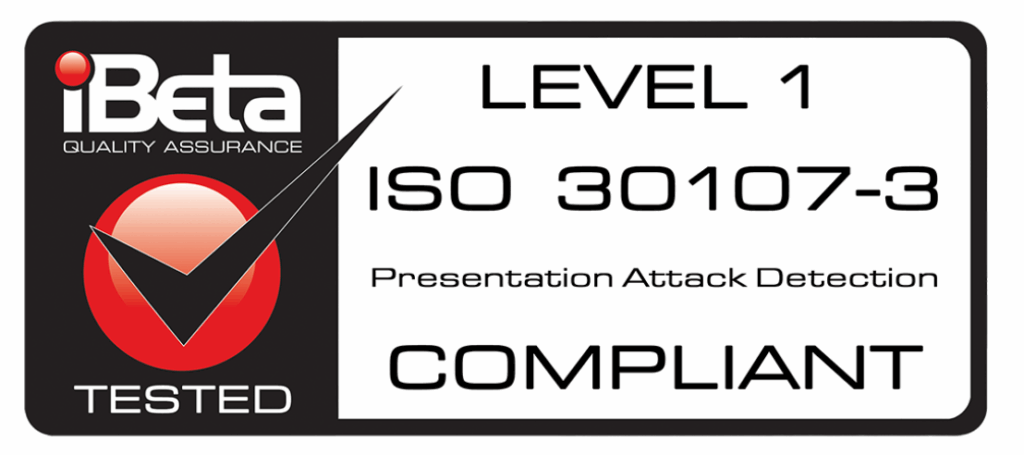
    Both facial age estimation and age verification solutions include patented on-device liveness detection, successfully passing and conforming to ISO/IEC 30107-3 iBeta PAD Level 1 and 2 presentation attack testing.

    4) Regulator-Ready, Globally

    PrivateID’s on-device age assurance solutions give companies a single, privacy-preserving foundation to:

    • Satisfy Australia’s under-16 social media restrictions
    • Align with the EU Digital Services Act (DSA) and its expectations for proportionate, privacy-focused age assurance
    • Support UK Online Safety Act obligations for robust age checks on adult content and other high-risk or harmful online services
    • Address emerging US state-level social media and youth safety laws that mandate effective age verification and protections for minors
    • Enforce age gates for regulated digital products and content – such as gambling, gaming, alcohol, and adult entertainment – where strong age checks are already required or rapidly becoming mandatory

    Our privacy-preserving, on-device technology helps organizations meet Australia’s new under-16 social media rules and broader global age requirements with strong assurance and edge-only processing—delivered without user or parental consent friction—enabling companies to stay ahead of a rapidly evolving landscape of age-based regulation.

  • PrivateID Achieves Successful Completion of iBeta PAD Level 1 & Level 2 Assessments with Its Passive, On-Device Liveness Detection

    PrivateID Achieves Successful Completion of iBeta PAD Level 1 & Level 2 Assessments with Its Passive, On-Device Liveness Detection

    In an important milestone for privacy-preserving identity technology, PrivateID has successfully completed the internationally recognized iBeta Presentation Attack Detection (PAD) Level 1 and Level 2 assessments. This achievement validates the strength, resilience, and reliability of PrivateID’s passive, on-device liveness detection—a core capability of its decentralized biometric identity platform.

    iBeta Quality Assurance, the globally accredited lab responsible for testing biometric performance and anti-spoofing defenses, conducts stringent evaluations to ensure that biometric systems can withstand real-world presentation attacks. Passing PAD Levels 1 and 2 places PrivateID in an elite category of biometric technologies capable of defending against increasingly sophisticated spoofing attempts.

    What the iBeta PAD Certification Means

    The ISO/IEC 30107-3 standard defines how biometric systems should detect presentation attacks such as:

    • Printed photos
    • High-resolution digital images or videos
    • Silicone masks
    • Life-like 3D replicas
    • Replay or injection attacks

    PAD Level 1 tests basic presentation attacks, while PAD Level 2 introduces more advanced, high-quality spoofing artifacts that are significantly harder to detect.

    PrivateID’s successful completion of both levels demonstrates that its liveness detection reliably distinguishes between a real person and sophisticated spoofing materials—all without capturing or transmitting any biometric images from the device.

    ISO/IEC 30107-3 standard

    Passive. On-Device. Privacy-Preserving.

    A major differentiator for PrivateID is its privacy-first, decentralized architecture:

    ✔ Passive Liveness Detection

    PrivateID’s solution does not require user prompts such as blinking, head turns, or specific actions. Liveness is detected seamlessly in the background, creating a frictionless user experience.

    ✔ Fully On-Device Processing

    All biometric templates and liveness checks happen locally on the user’s device. No images, videos, or raw biometric data are ever stored or sent to a server.

    ✔ Zero Biometric Storage

    The system never needs to hold or transmit biometric artifacts, eliminating the risks associated with centralized biometric databases or cloud-based matching.

    Strengthening Trust for Enterprises and Consumers

    The successful completion of PAD Levels 1 & 2 provides third-party validation that PrivateID’s approach is both secure and highly resistant to fraud, giving organizations confidence to deploy biometrics at scale across:

    • Regulated industries like financial services and healthcare
    • Workforce identity and access management
    • Retail experiences
    • Public sector digital identity programs
    • Consumer authentication for apps and devices

    The certification also reinforces PrivateID’s ability to defend against real-world adversarial conditions while maintaining an uncompromising privacy posture.

    A New Standard for Privacy-First Biometrics

    Most market biometrics rely on server-side matching, cloud-based liveness, or the storage of facial images—approaches that introduce privacy and regulatory risk. PrivateID flips the model by placing users in control and eliminating the need to store biometric data anywhere.

    With the successful completion of iBeta PAD 1 and PAD 2, PrivateID has demonstrated that privacy-preserving identity solutions can meet or exceed the performance and security expectations of the global biometric community.

    Looking Ahead

    PrivateID will continue advancing its decentralized identity architecture, strengthening biometric performance, and expanding interoperability with digital identity ecosystems, healthcare infrastructure, and credential service providers.

    The iBeta certifications mark a major milestone—but they are also the foundation for what comes next: enabling a future where strong identity, high security, and personal privacy coexist seamlessly while continuing to prevent the ever increasing sophistication of spoofing attempts.

  • Why the World’s Leading Enterprises Choose PrivateID: A Deep Dive Into Our Age Assurance Platform

    Why the World’s Leading Enterprises Choose PrivateID: A Deep Dive Into Our Age Assurance Platform

    Governments, platforms, and enterprises across the globe are facing unprecedented pressure to protect minors online, comply with rapidly evolving age-verification laws, and reduce exposure to privacy, security, and regulatory risk. From the EU Digital Services Act (DSA) to COPPA, GDPR, the UK Online Safety Act, and dozens of new national frameworks, organizations must now responsibly determine user age—without compromising privacy, user experience, or business performance.

    Yet most age-assurance technologies rely on server-side processing, the transmission of sensitive biometric data, or storage of personal information. These traditional approaches introduce compliance challenges, increase liability, and create friction for users.

    PrivateID solves these challenges at their core.

    Our Age Assurance Platform provides the safest, fastest, most private, and most accurate way to determine or verify user age—without ever sending images or PII off the user’s device. Built on advanced edge-computing technology and proven in global production environments for years, PrivateID has become the trusted choice for major enterprises across industries.

    This blog explores what makes our platform fundamentally different, what problems it solves, and why organizations consistently choose PrivateID over traditional competitors.

    The Foundation: Edge-Based Processing for Maximum Privacy and Speed

    At the heart of PrivateID’s platform is a simple but powerful architectural principle:

    All core processing—biometric capture, age estimation, matching, liveness detection, and document data extraction—runs directly on the user’s device.

    No images or personal data are transmitted or stored. Processing is performed in real time through:

    • WebAssembly (WASM) for browser-based flows
    • Native iOS (Swift) and Android (Kotlin) SDKs
    • Python and C SDKs for enterprise and embedded environments

    This architecture yields transformative advantages:

    • No user consent required, including for minors under COPPA
    • No GDPR, CCPA, BIPA, or HIPAA data exposure
    • Ultra-low latency and real-time feedback
    • Reduced fraud and spoofing risk
    • Minimal bandwidth dependency
    • A frictionless, high-conversion user experience

    This is why major global enterprises have relied on PrivateID for years—our system eliminates the data-handling liabilities that make most age verification solutions high-risk.

    PrivateID Age Estimation and Age Verification

    Two Core Solutions: Age Estimation and Age Verification

    PrivateID’s Age Assurance Platform consists of two primary solutions that can be used independently or together depending on regulatory or business requirements.

    1. Facial Age Estimation (On-Device + Liveness)

    PrivateID’s on-device facial age estimation uses advanced deep-learning models to determine probable user age with exceptional accuracy. The system includes iBeta PAD Level 1 and Level 2 certified liveness detection, protecting against attacks such as:

    • Printed photos
    • Digital screen replays
    • 3D printed masks
    • Deepfakes

    It supports both still images and continuous video streams, making it ideal for:

    • Social platforms
    • Live-streaming apps
    • UGC environments
    • Online communities
    • Content moderation workflows

    Because all inference runs locally, users receive real-time guidance (“improve lighting,” “move closer,” “center your face”) to complete the process quickly.

    The accuracy of the system is independently validated:

    • EAL3 certification through the Age Check Certification Scheme (ACCS)
    • Benchmark-tested with the lowest Mean Absolute Error (MAE) among leading competitors

    This combination of privacy, speed, accuracy, and security is unmatched in the industry.

    2. Age Verification (Selfie + Government ID) — 100% On-Device

    When regulations require more formal verification, PrivateID provides a full on-device selfie + ID verification workflow.

    The user captures a selfie and a photo of a government-issued ID.
    PrivateID performs:

    • On-device 1:1 facial matching to confirm the ID belongs to the holder
    • On-device liveness detection
    • On-device OCR and date-of-birth extraction

    Again, no image or PII leaves the device.

    This workflow meets the needs of more regulated industries such as retail, financial services, healthcare, online marketplaces, and age-restricted commerce.

    When organizations require even higher assurance, PrivateID offers optional server-based checks—including forensic document inspection and attribute verification—capable of achieving NIST 800-63-3 IAL2 standards. These checks require temporary server processing but all images are deleted immediately after use.

    Just like our facial age estimation system, the on-device nature of this workflow eliminates the need for user consent and significantly simplifies compliance.

    Why Major Enterprises Choose PrivateID Over Competitors

    Organizations select PrivateID for reasons that go beyond privacy alone. Our platform delivers a combination of technological, operational, and compliance advantages that competitors cannot match.

    Unmatched Privacy and Regulatory Compliance

    With no data ever leaving the device, PrivateID minimizes compliance exposure across:

    • COPPA
    • GDPR
    • CCPA
    • BIPA
    • HIPAA
    • EU DSA
    • UK Online Safety Act

    This dramatically reduces regulatory burdens across global markets.

    Superior Accuracy and Security

    PrivateID consistently ranks at the top of industry benchmarks, with:

    • Lowest MAE in competitive testing
    • ACCS EAL3 certification
    • iBeta PAD 1 & PAD 2 certification

    These third-party validations give enterprises confidence in real-world performance.

    Real-Time Speed and Ultra-Low Latency

    Edge processing avoids network delays, enabling:

    • Instant results
    • Higher conversion rates
    • Lower abandonment
    • Real-time user feedback
    • Robustness in low-bandwidth environments

    Support for Use Cases Competitors Cannot Address

    PrivateID enables capabilities other providers simply cannot match, such as:

    • Embedding age estimation and liveness detection directly into live-streaming or video content
    • Fully offline or poor-network workflows
    • High-scale edge-native deployments
    • Embedded device and IoT integration via C SDK

    Flexible Deployment Models

    Customers can deploy PrivateID as:

    • SaaS (hosted by PrivateID)
    • PaaS (hosted in the customer’s cloud: AWS, GCP, Azure)
    • Hybrid implementations
    • API-based flows (optional and less privacy-preserving)

    Proven Global Scale

    PrivateID’s solutions have been deployed for years, powering high-volume, high-reliability workflows for some of the largest enterprises in the world across multiple continents.

    Key Use Cases Across Industries

    PrivateID solves age assurance challenges across numerous categories:

    Online Platforms & UGC Networks

    • Complying with DSA, COPPA, UK OSA
    • Protecting minors from adult content
    • Enforcing age-based feature restrictions

    Social Media & Live-Streaming

    • Real-time age estimation within video workflows
    • Preventing underage broadcasting or participation
    • Automated safety triggers

    Retail, E-Commerce & Age-Restricted Products

    • Alcohol, tobacco, vapes
    • Lottery & gaming
    • Prescription products
    • Age-restricted marketplaces

    Gaming, Esports & Metaverse

    • In-world age gating
    • Ensuring compliance with parental control laws
    • Moderating age-specific content

    Healthcare & Telemedicine

    • Verifying eligibility for services
    • Enabling privacy-first patient onboarding

    Physical Access & Workforce Management

    • Age verification for restricted facilities
    • Secure identity checks without server dependencies

    The Future of Age Assurance Is On-Device

    As global expectations for privacy strengthen and governments introduce increasingly strict age-assurance requirements, organizations need solutions that are both effective and respectful of user rights.

    PrivateID delivers exactly that.

    Our on-device, privacy-first architecture combined with industry-leading accuracy, speed, and certified security makes PrivateID the most advanced and trusted age assurance platform in the world.

    With years of proven global deployments and a roadmap built around continuous innovation, PrivateID is redefining what safe, compliant, and user-friendly age assurance looks like.

  • PrivateID: A Full Service CSP Certified by Kantara at IAL2 and AAL2

    PrivateID: A Full Service CSP Certified by Kantara at IAL2 and AAL2

    Private Identity, known as PrivateID, has reached an important milestone in the evolution of digital identity. It is now a full service Credential Service Provider certified by the Kantara Initiative under the NIST Special Publication 800 63 3 framework. This achievement validates PrivateID at Identity Assurance Level 2 and Authenticator Assurance Level 2, the same federal grade benchmarks relied on across healthcare, financial services, government programs, and regulated industries.

    For organizations that depend on strong identity assurance, this certification is more than a badge. It is independent confirmation that PrivateID meets the highest expectations for privacy, security, verification integrity, and operational readiness.

    What the Kantara Certification Means

    Kantara’s certification process is one of the most rigorous identity assessment programs in the world. It requires a complete, independent audit of identity proofing, credential issuance workflows, authentication flows, data protection controls, operational standards, and the policies that support them.

    PrivateID successfully demonstrated that its identity proofing, verification decisioning, and biometric authentication architecture follow recognized federal standards. This includes requirements around enrollment integrity, secure capture of identity evidence, confidence scoring, risk based verification, phishing resistance, and cryptographic strength.

    By earning IAL2 and AAL2, PrivateID has proven that it can confirm an individual’s identity to a high degree of assurance and can authenticate users with strong protection against credential theft or impersonation attempts, including those often seen in account takeover fraud and targeted phishing.

    What Kantara Certified Means

    Privacy and Assurance by Design

    One of the core reasons PrivateID stands out in the identity landscape is its privacy preserving architecture. Many identity verification solutions still rely on transmitting facial images, storing biometric templates, or centralizing sensitive information in cloud infrastructures. These practices introduce significant risk and increase exposure under global privacy laws.

    PrivateID takes a different approach. All biometric processing, including matching and liveness detection, takes place entirely on the user’s device. No photos are uploaded. No biometric templates are transmitted or stored. No face data is ever centralized.

    This approach removes one of the largest threat surfaces within the identity ecosystem. Since nothing leaves the device, the platform avoids the most common causes of biometric data breaches. It also minimizes regulatory burden under GDPR, CCPA, HIPAA, BIPA, and the many emerging privacy laws around the world.

    PrivateID’s identity proofing workflow follows the Kantara and NIST guidelines for collecting and processing only the minimum necessary personally identifiable information. Sensitive data is handled within a controlled and audited process that adheres to federal and international standards. At the same time, all biometric authentication remains device bound and private at all times.

    PrivateID’s commitment to security is reinforced by its adherence to leading frameworks such as ISO 27001, SOC 2 Type II, and IEEE 2410. These standards contribute to the security and reliability foundation required for enterprise grade deployment.

    Why Kantara Certification Matters

    Organizations across regulated industries face increasing pressure to verify identities accurately while protecting users from unnecessary data exposure. Kantara’s certification offers external proof that PrivateID’s identity proofing and authentication workflow meets established federal benchmarks and can be trusted for high risk environments.

    This certification also simplifies compliance for organizations that rely on PrivateID. Healthcare providers working under TEFCA can trust that identity and authentication flows meet approved guidelines. Financial institutions can align with FFIEC and AML requirements with less integration complexity. Government programs can support citizen enrollment and digital service access with higher confidence in the underlying identity verification process.

    In many ways, the certification serves as assurance for partners, regulators, and enterprise buyers that PrivateID is capable of issuing and managing trusted digital identities at scale without compromising privacy.

    How PrivateID Strengthens Identity Assurance

    PrivateID’s verification architecture combines several important elements that support high assurance identity programs.

    On device biometric processing
    Biometric verification and liveness detection happen entirely on the user’s device. This eliminates cloud vulnerability and reduces regulatory exposure.

    Privacy preserving identity proofing
    PrivateID extracts only the minimum required information from user supplied documents and identity evidence while keeping biometric data localized.

    Phishing resistant authentication
    PrivateID supports strong passwordless authentication based on passkeys and on device biometrics that cannot be intercepted or replayed.

    Federally aligned workflows
    PrivateID meets NIST 800 63 3 IAL2 and AAL2 requirements, which simplifies compliance for organizations that integrate identity proofing and access control.

    Standards based trust
    PrivateID supports verifiable credentials, decentralized onboarding workflows, and identity exchange models consistent with modern identity frameworks.

    These capabilities make PrivateID suitable for high trust environments where accuracy, privacy, and operational reliability are essential.

    Private ID Kantara Certified

    Real World Use Cases

    PrivateID’s Kantara certified architecture supports a wide range of scenarios across regulated and high assurance industries.

    Healthcare Access and TEFCA Alignment
    Hospitals, clinics, and health information networks can use PrivateID for identity proofing patients, providers, and staff in accordance with TEFCA’s identity requirements.

    Financial Services and AML Requirements
    Banks and fintech organizations can verify customers with confidence and authenticate users in a phishing resistant, passwordless workflow that aligns with federal guidance.

    Workforce IAM in Regulated Environments
    Enterprises can deploy strong, private, compliant onboarding flows for employees, contractors, and partners without storing biometric information or exposing PII.

    Verifiable Credentials and Digital Wallets
    PrivateID can issue identity verified credentials that support digital wallets, decentralized ecosystems, and cross platform identity portability.

    These use cases expand continuously as organizations search for identity systems that maintain high assurance without compromising privacy.

    Looking Ahead

    Digital identity is shifting toward a future where privacy and security must operate together. Kantara’s certification validates that PrivateID is aligned with this direction. By meeting IAL2 and AAL2 requirements, PrivateID demonstrates that modern identity can be private, strong, and efficient without relying on outdated models that expose users to unnecessary risk.

    As the global identity ecosystem moves toward verifiable credentials, decentralized identifiers, and privacy preserving authentication, PrivateID is positioned to support governments, enterprises, and individuals with a secure and future ready framework.

    Frequently Asked Questions About Kantara Certification and PrivateID

    What does it mean to be a Kantara certified CSP at IAL2 and AAL2

    It means PrivateID has passed a rigorous independent assessment confirming that its identity proofing and authentication processes meet recognized federal standards for accuracy, security, and operational integrity.

    How does PrivateID protect user privacy

    All biometric processing happens on the user’s device so no facial images, templates, or sensitive biometrics are transmitted or stored. PII is handled in a controlled workflow that aligns with Kantara and NIST requirements.

    Why is IAL2 important for identity proofing

    IAL2 establishes a high confidence level that the person being verified is who they claim to be, based on validated identity evidence and audited verification procedures.

    Why is AAL2 important for authentication

    AAL2 ensures authentication is phishing resistant and resistant to common credential attacks through the use of strong passkeys and on device biometrics.

    Which industries benefit most from this certification

    Healthcare, finance, government services, workforce identity programs, and any organization that requires trusted digital identity and strong authentication.

  • How Liveness Detection Is Powering the Next Generation of Secure Biometric Authentication

    How Liveness Detection Is Powering the Next Generation of Secure Biometric Authentication

    Biometric authentication has become part of everyday life. We unlock our phones with a glance, verify payments with a quick face scan, and check in at airports without handing over a boarding pass. But none of this would be possible—or secure—without one essential safeguard: liveness detection.

    Even the most advanced facial or fingerprint recognition system can be fooled by a fake image or AI-generated clone if it cannot tell whether a real human is present. As deepfake technology and digital spoofing evolve, the security industry faces a new challenge: ensuring that identity verification remains not just accurate, but alive.

    This guide explores what liveness detection is, why it matters, how it works, and how privacy-preserving platforms like PrivateID are shaping its future.

    Key Takeaways

    • Liveness detection verifies that biometric input comes from a live person, not a spoof.
    • Active and passive methods balance accuracy, convenience, and compliance.
    • Layered techniques—texture, depth, motion, and vital-sign analysis—deliver robust protection.
    • Applications span banking, healthcare, retail, border control, and the workplace.
    • Privacy-preserving, on-device AI like PrivateID’s Edge technology ensures speed, accuracy, and complete data ownership.

    What Is Liveness Detection

    Liveness detection uses algorithms, sensors, and AI models to confirm that a biometric sample—such as a face, fingerprint, or voice—comes from a live human being rather than a static image, replayed video, or mask. When you unlock your phone or access a secure system, it silently looks for tell-tale signs of life: eye movement, skin texture, heat, depth, or tiny micro-expressions.

    It’s not a small detail. Without liveness checks, a printed photo, 3D mask, or deepfake could pass as a legitimate user. The entire premise of biometric authentication depends on knowing the difference between a recording and a real person.

    Why Liveness Detection Matters in Modern Security

    Why Liveness Detection Matters in Modern Security

    Biometrics changed authentication forever—but they also introduced new attack surfaces. Cybercriminals now use 3D-printed fingerprints, silicone masks, and AI-generated faces to impersonate victims. These spoofing attempts are cheap, fast, and disturbingly convincing.

    That’s why liveness detection has become non-negotiable. It adds a verification layer that distinguishes the living from the synthetic, blocking fraudulent access even when the biometric data itself is stolen or replicated.

    A well-designed liveness system provides:

    • Fraud prevention: Eliminates impersonation attempts across financial, healthcare, and government workflows.
    • Privacy protection: Reduces the need to store raw biometric data by validating users locally.
    • User confidence: Builds trust that their digital identity cannot be hijacked by an AI-generated replica.
    • Compliance readiness: Meets privacy frameworks like GDPR, CCPA, and emerging AI governance laws.

    Consider the difference in user experience: a traditional cloud-based face scan sends data to a remote server, increasing exposure risk. By contrast, PrivateID’s on-device AI verifies liveness within 25 milliseconds, never transmitting or storing an image. This approach eliminates centralized biometric databases—often the target of breaches—and aligns with the NIST Digital Identity Guidelines, which advocate privacy-by-design.

    For organizations, liveness detection isn’t just security—it’s brand protection. A single spoofed account can trigger regulatory fines, reputational harm, and loss of consumer trust. A frictionless, real-time verification process restores confidence for both users and auditors.

    Core Methods of Liveness Detection

    Active and Passive Detection

    Active liveness detection requires interaction. Users may be prompted to blink, smile, or follow on-screen movement cues. The software then evaluates these organic micro-motions to confirm authenticity. It offers high reliability but can feel slightly intrusive.

    Passive liveness detection runs silently in the background, analyzing skin texture, depth, or spontaneous movements. It requires no action from the user and suits mobile apps or remote onboarding experiences.

    PrivateID’s platform supports both, giving developers flexibility to balance assurance and convenience across use cases.

    Leading Techniques Used in Liveness Detection

    • Texture and Reflection Analysis – Evaluates light diffusion and moisture on real skin versus artificial surfaces.
    • Depth Sensing – Uses infrared or 3D mapping to differentiate flat screens from real contours.
    • Micro-Expression Tracking – Detects involuntary blinks, pupil movement, and subtle facial twitches.
    • Challenge-Response Tests – Prompts timed gestures or spoken phrases, which static media can’t mimic.
    • Vital-Sign Monitoring – Reads micro color changes caused by heartbeat or blood flow for biological proof.

    The strongest systems combine several techniques. PrivateID’s MediaSafe™ engine extends this further by analyzing facial patterns in video streams to flag deepfakes or injected synthetic faces while maintaining complete on-device privacy.

    Challenges and Limitations in Liveness Detection

    Liveness detection continues to evolve—and so do its adversaries.

    • Hyper-realistic spoofs: Silicone masks and neural-rendered videos can deceive weak algorithms.
    • Environmental variability: Poor lighting, low-quality cameras, or face coverings can reduce accuracy.
    • False rejections: Users with disabilities or unique facial traits sometimes trigger errors.
    • Data exposure: Systems that upload biometrics to the cloud risk breaches and regulatory violations.

    PrivateID’s Edge AI mitigates these issues by processing data locally with homomorphic tokens. Since no image or personally identifiable information ever leaves the device, privacy risks and legal exposure are dramatically reduced.

    True resilience comes from combining accuracy with user experience. A system that’s perfectly secure but frustrating to use will fail in real-world deployment. Edge-based verification gives both—real-time authentication with near-zero friction.

    Challenges and Limitations in Liveness Detection

    Applications Across Industries

    Banking and Finance

    Financial institutions use liveness detection to secure mobile logins, remote account openings, and high-value transactions. It blocks account-takeover attempts driven by stolen biometrics and meets KYC/AML compliance requirements. Edge verification also improves approval rates by reducing manual review delays.

    Healthcare

    Hospitals employ liveness detection to confirm patient identities before granting access to electronic health records or prescription systems. It prevents insider fraud, supports HIPAA compliance, and enables password-free authentication for staff moving between secure workstations.

    Government and Border Control

    E-passports, visa kiosks, and airport gates rely on liveness detection to prevent impersonation. Governments increasingly require technologies certified to standards such as NIST 800-63 AAL2, achieved by PrivateID’s FIDO2 Ultrapass™. Real-time verification streamlines border crossings while keeping personal data under user control.

    Retail and E-Commerce

    Retailers integrate face and voice authentication for loyalty programs, checkouts, and fraud prevention. Liveness checks ensure that transactions originate from real customers, not bots or replayed credentials, improving trust at every digital touchpoint.

    Workplace Security

    Organizations apply liveness verification for physical access control, remote workforce management, and privileged account logins. PrivateID’s SDKs enable instant deployment across web and mobile environments with minimal development overhead.

    Across every sector, liveness detection transforms static identity checks into continuous, trustworthy authentication.

    Emerging Trends in Liveness Detection Technology

    Smarter AI and Adaptive Learning

    Next-generation algorithms use self-training models that adapt to new attack vectors in real time. They can learn the difference between normal human movement and AI-generated mimicry, reducing false negatives while maintaining accuracy. Combined with synthetic training data, these systems anticipate threats before they reach production.

    Multi-Modal Biometrics

    Future authentication will integrate multiple signals—facial, voice, iris, and behavioral biometrics—to build comprehensive trust profiles. When one signal is uncertain, another confirms identity. PrivateID’s modular platform already supports these combined modalities across its privacy-preserving SDK suite.

    Privacy-Enhancing Computation

    Data minimization is becoming central to digital identity. Edge AI, federated learning, and encrypted matching now let models verify identities without ever collecting raw data. PrivateID’s on-device framework achieves this in milliseconds, aligning with both GDPR and the European Commission’s Data Protection Principles.

    This architectural shift—from central storage to local computation—marks the single biggest leap in digital identity security since public-key cryptography.

    Integration with AR and VR

    As virtual and augmented reality expand into enterprise collaboration and e-commerce, verifying digital presence becomes crucial. Liveness detection ensures that avatars or digital twins represent real, authenticated users. PrivateID’s MediaSafe™ operates inside video streams to detect deepfakes in immersive environments, securing tomorrow’s metaverse interactions.

    AI Governance and Global Policy Alignment

    Governments are drafting AI accountability laws requiring explainability and audit trails for biometric systems. Organizations that deploy transparent, privacy-first architectures—like PrivateID’s homomorphic edge processing—will meet future mandates faster and avoid costly retrofits.

    Emerging Trends in Liveness Detection Technology

    Compliance and Ethical Governance

    Liveness detection doesn’t exist in a vacuum—it sits at the intersection of security, ethics, and law. Responsible deployment demands:

    • Transparency: Users must understand what data is collected and how it’s used.
    • Auditability: Regular testing for accuracy, bias, and demographic fairness.
    • Retention control: Clear data deletion and lifecycle management.
    • Ethical AI: Training on synthetic, privacy-exempt datasets to prevent exploitation.

    PrivateID implements all four pillars. Its systems use synthetic facial data to eliminate bias while maintaining accuracy, and its privacy-by-design framework ensures compliance in over 195 countries. The World Economic Forum’s Digital Trust Report reinforces that these governance models are essential for sustaining public confidence in biometric identity systems.

    For further insight, explore PrivateID’s Deepfake Detection and Facial Recognition Software platforms—both built on the same ethical AI foundation.

    The Road Ahead

    In the coming years, liveness detection will fade into the background of user experience—instant, adaptive, and invisible. Verification will happen in under a second, powered by contextual signals from devices and environments.

    PrivateID already represents that future. Its real-time edge processing verifies user presence in just 25 milliseconds, combining liveness, deepfake defense, and face matching into a single privacy-preserving workflow. By eliminating central databases and replacing them with encrypted on-device computation, PrivateID allows global organizations to authenticate securely without ever collecting personal data.

    The mission is simple: build authentication that protects people first and scales ethically for the entire digital ecosystem.

    Conclusion

    Liveness detection is no longer optional—it’s the foundation of digital trust. It ensures that every biometric transaction originates from a living, consenting human being and that personal data stays private.

    PrivateID’s innovation proves that performance and privacy can coexist. By merging speed, accuracy, and regulatory compliance, it sets a new benchmark for responsible identity verification.

    The next era of authentication will not rely on passwords or cloud databases—it will rely on intelligence at the edge, verifying life itself.

    Frequently Asked Questions About Liveness Detection

    What is liveness detection in biometric authentication

    It’s the process of verifying that a biometric input comes from a real, live person instead of a spoofed image or recording. Without it, biometrics can be fooled by deepfakes or replicas.

    How does liveness detection stop spoofing attacks

    It examines depth, texture, motion, and micro-movements to detect forgeries. With edge-based AI, detection happens locally in milliseconds, keeping biometric data private.

    What types of liveness detection exist

    Active detection requires small user actions, like blinking or turning the head. Passive detection analyzes natural human cues automatically.

    Why is liveness detection critical for digital security

    It prevents fraud, identity theft, and deepfake abuse, ensuring authentication systems remain both safe and user-friendly.

    Can liveness detection be fooled

    Advanced spoofs occasionally challenge weaker models, but layered defenses and adaptive AI—like those in PrivateID’s system—make successful attacks exceedingly rare.

    How is liveness detection evolving

    It’s becoming faster, fairer, and more private through synthetic training data, multi-modal biometrics, and on-device AI that completes verification within milliseconds.